






Bamboo storage racks earn their eco-friendly reputation through measurable science, not marketing language. From rapid carbon sequestration during growth to full biodegradability at end of life, every stage of a bamboo rack's lifecycle stands in stark contrast to the resource-intensive, slow-to-decompose alternatives that dominate the conventional storage market. This article breaks down exactly what makes a bamboo storage rack genuinely sustainable, backed by peer-reviewed data.
How Fast Does Bamboo Actually Grow, and Why Does It Matter?
Sustainability begins at the source, and bamboo's growth profile is genuinely exceptional. Moso bamboo (Phyllostachys edulis)[¹] - the dominant species used in commercial bamboo product manufacturing - reaches near-maximum culm height within just 40 days of shoot emergence, according to research indexed by Nature Index, during which it accumulates up to three-quarters of its total five-year standing biomass. Full structural maturity for harvest is typically reached within 5–6 years.
Compare this to hardwood trees used in conventional furniture and rack production, which require 20–60 years to reach comparable harvestable maturity. This dramatic difference in growth cycle[²] means bamboo plantations can be harvested repeatedly on a rotating basis without replanting - the root rhizome system regenerates new culms continuously - while hardwood forestry requires decades of regrowth after each harvest.
This rapid renewability is the foundational reason a bamboo storage rack carries fundamentally lower resource pressure than products made from slow-growing timber or non-renewable petrochemical inputs.

What Does the Science Say About Bamboo's Carbon Sequestration?
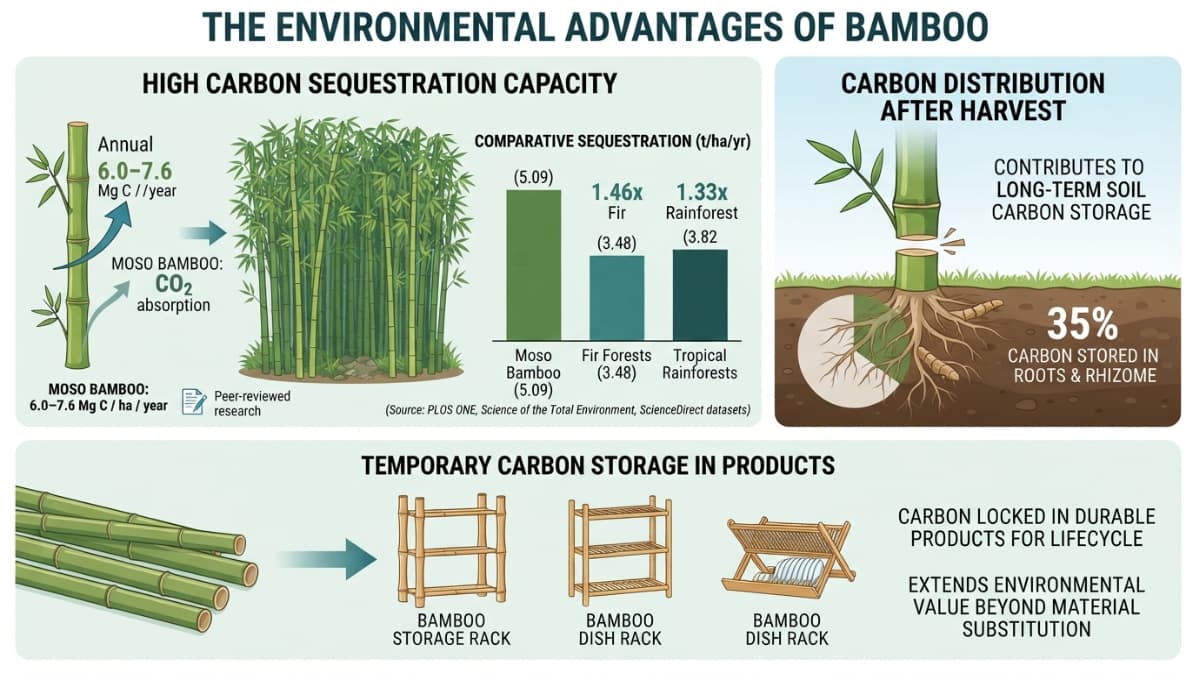
One of the most compelling environmental advantages of bamboo is its high carbon sequestration capacity during growth. Peer-reviewed field research published in PLOS ONE, based on studies of 36 Moso bamboo plots across Fujian, Zhejiang, and surrounding provinces-including Jian'ou County, where our manufacturing operations are located-measured annual carbon sequestration rates of approximately 6.0–7.6 Mg C per hectare per year in standing bamboo biomass.
Additional research published in Science of the Total Environment reports that Moso bamboo can achieve sequestration rates of around 5.09 t/ha per year, which the study notes is approximately 1.46 times higher than fir forests and 1.33 times higher than tropical rainforests on a per-hectare basis. Other studies indexed in ScienceDirect have reported even higher values for managed bamboo plantations, depending on species selection and cultivation practices.
What makes these figures particularly relevant is how carbon is distributed within the plant system. According to the same PLOS ONE dataset, a significant portion of carbon-around 35%-remains stored in the root and rhizome system after harvesting. This underground biomass continues to contribute to long-term soil carbon storage even after the above-ground culm is used for manufacturing.
When the harvested bamboo culm is processed into products such as a bamboo storage rack or bamboo dish rack, the carbon absorbed during its growth remains effectively locked within the material for the entire product lifecycle. In this way, bamboo products function not only as durable household goods but also as temporary carbon storage systems, extending their environmental value beyond simple material substitution.
Does Manufacturing Bamboo Racks Require Less Energy Than Alternatives?
Sequestration during growth is only half the sustainability picture - manufacturing energy intensity matters equally. Bamboo culm processing into finished rack panels involves mechanical cutting, kiln drying, and surface treatment - a comparatively low-energy industrial chain relative to the alternatives.
Steel production, by contrast, requires ore mining, blast furnace smelting at temperatures exceeding 1,500°C, and rolling - an energy-intensive sequence reflected in the World Steel Association's documented figure of 1.92 tonnes of CO₂ emitted per tonne of crude steel produced. Plastic rack manufacturing begins with crude oil or natural gas extraction, followed by cracking, polymerization, and injection molding - processes entirely dependent on non-renewable fossil feedstocks.
Bamboo processing requires no mining, no smelting, and no petrochemical cracking. The primary energy inputs are mechanical (cutting, planing, lamination pressing) and thermal (kiln drying, carbonization), both of which can be - and increasingly are - powered by renewable energy sources in modern bamboo manufacturing facilities, particularly in China's bamboo-producing provinces where hydroelectric power is regionally abundant.

Is Bamboo Genuinely Biodegradable at the End of Its Life?
One of bamboo's greatest sustainability advantages becomes clear at the end of its service life. Unlike plastic or composite materials, bamboo is a natural plant-based material composed primarily of cellulose, hemicellulose, and lignin. Under suitable composting or soil conditions, it can naturally decompose through microbial activity, returning to the environment without leaving behind long-term waste.
Plastic follows a very different path. According to the OECD Global Plastics Outlook, conventional plastics can remain in the environment for 400–500 years before fully breaking down. The same report found that of the 353 million tonnes of plastic waste generated worldwide in 2019, only 9% was successfully recycled. Most of the remainder was sent to landfills, incinerated, or leaked into the environment-including 6.1 million tonnes that entered aquatic ecosystems in a single year.
A bamboo dish rack, spice rack, or storage shelf has a much smaller end-of-life impact. When disposed of appropriately, bamboo gradually breaks down into organic matter over time without generating persistent plastic waste or microplastic pollution.
While no manufactured product is completely impact-free, bamboo's natural biodegradability gives it a clear advantage over synthetic storage materials. Combined with its renewable origin, long service life, and lower reliance on fossil resources, this makes bamboo a more environmentally responsible choice for consumers looking to reduce their long-term environmental footprint.

Does Sustainable Bamboo Sourcing Require Special Certification?
Not all bamboo products carry the same level of environmental responsibility. For buyers seeking a genuinely sustainable bamboo storage rack, understanding sourcing practices is just as important as evaluating the product itself.
According to the Food and Agriculture Organization (FAO), China has the largest cultivated bamboo resource in the world, with major production regions concentrated in provinces such as Fujian, Zhejiang, Jiangxi, and Hunan. These regions are also widely referenced in academic studies on bamboo ecology and carbon performance, including research on Moso bamboo systems.
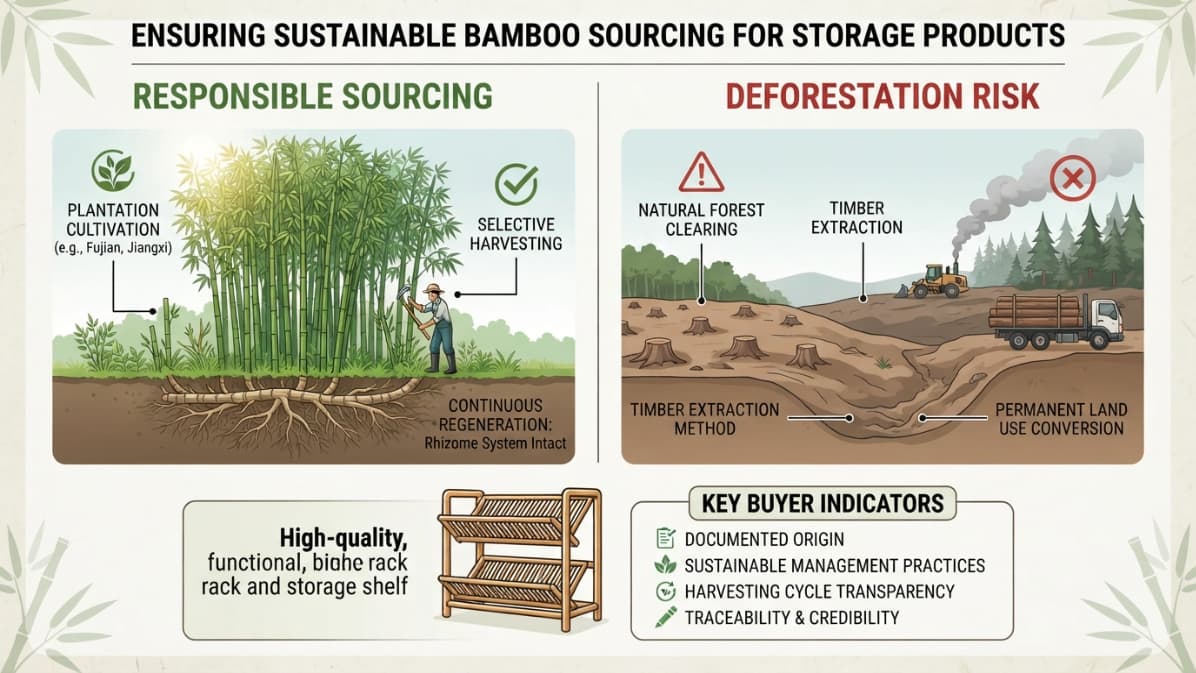
In well-managed supply chains, bamboo is harvested from plantation-based cultivation systems, not from natural forest clearing. This is an important distinction. Bamboo plantations are designed for periodic harvesting of mature culms while leaving the underground rhizome system intact, allowing continuous regeneration without replanting or land degradation. Unlike deforestation-based timber extraction, this process does not require permanent removal of vegetation or conversion of land use.
For buyers and importers, sourcing transparency is a key indicator of credibility. Reputable manufacturers should be able to provide clear documentation of bamboo origin, plantation management practices, and harvesting cycles. This level of traceability helps ensure that a bamboo dish rack or storage product is not only functional and durable, but also aligned with responsible environmental practices.
In short, sustainability in bamboo products is not just about the material itself-it also depends on how and where it is grown, harvested, and processed.
What Role Does Bamboo's Strength Play in Long-Term Sustainability?
Sustainability is often framed around materials and production methods, but durability plays an equally important role. Products that last longer reduce replacement frequency, which in turn lowers their overall environmental impact across the full lifecycle.
Bamboo stands out in this respect due to its strong mechanical performance. According to The Wood Database, bamboo achieves a Janka hardness[⁴] of 1,410–1,610 lbf and a modulus of rupture (MOR) of 76.0–168.6 MPa, placing it within the range of many hardwoods and well above the structural requirements for typical household storage applications.
Academic research published on ScienceDirect further highlights bamboo's engineering potential, noting its exceptionally high strength-to-weight ratio and tensile performance, which in some cases can approach that of steel when used in engineered applications.
In real-world use, these material properties translate into long-term reliability. A well-manufactured bamboo storage rack-properly kiln-dried, finished, and maintained with occasional food-safe mineral oil-can typically provide 5–10 years of stable household performance. This extended service life reduces the need for frequent replacement, which is one of the most significant contributors to environmental impact over time.
Viewed across its full lifecycle, bamboo's durability significantly strengthens its sustainability profile, making it a practical, long-lasting alternative to shorter-lived plastic and lower-grade metal storage products.

Bringing It All Together: Why the Eco-Friendly Claim Holds Up
From raw material to end of life, bamboo offers a more sustainable approach to home storage. It grows to maturity in just a few years, naturally absorbs carbon during its growth cycle, requires relatively low energy to process, and provides years of reliable performance in everyday household use. At the end of its service life, bamboo is biodegradable under appropriate conditions, making it a more environmentally friendly alternative to many conventional materials.
These advantages are supported by material science and environmental research-not simply marketing claims. For homeowners seeking storage solutions that combine durability, functionality, and sustainability, bamboo is a practical choice backed by real-world performance.

Explore our collection of bamboo dish racks, bamboo spice racks, bamboo baker's racks, bamboo countertop shelves, and other bamboo storage solutions. Responsibly manufactured from premium Fujian bamboo, our products are designed to bring lasting organization, natural beauty, and sustainable value to modern homes.
👉 Shop Sustainable Bamboo Dish Racks | Browse Eco-Friendly Bamboo Kitchen Organizers | Explore Our Complete Bamboo Storage Collection
FAQ
Q: If I throw away a bamboo rack, does it actually decompose, or does it just sit in a landfill like everything else?
A: It genuinely decomposes. Composted or buried in soil, bamboo breaks down into organic matter within months to a few years - nothing like the 400-plus years plastic takes. Even in a standard landfill, it decomposes far faster than synthetic materials because it's just plant fiber, not polymer chains.
Q: Does growing all this bamboo for furniture and racks contribute to deforestation somewhere?
A: Not in the way clear-cutting hardwood forests does. Bamboo is harvested from managed plantations where the root system stays in the ground and regrows new culms continuously - no replanting, no permanent land clearing. It's a fundamentally different harvest model than timber forestry.
Annotations
[¹] Moso bamboo (Phyllostachys edulis) - the most widely cultivated bamboo species in China, accounting for approximately 70% of total bamboo forest cover in the country; the primary species used in commercial bamboo manufacturing due to its rapid growth, large culm diameter, and favorable mechanical properties.
[²] Growth cycle - the time period from initial planting or shoot emergence to harvestable maturity; bamboo's 5–6 year cycle stands in sharp contrast to the 20–80 year cycles typical of hardwood and softwood timber species used in conventional furniture manufacturing.
[³] Carbon sequestration - the process by which plants capture atmospheric CO₂ through photosynthesis and store it as carbon within plant biomass (stems, leaves, roots) and surrounding soil; typically measured in megagrams of carbon per hectare per year (Mg C ha⁻¹ yr⁻¹).
[⁴] Janka hardness - a standardized test measuring a material's resistance to surface indentation, expressed in pounds-force (lbf); used to compare the structural durability of wood and wood-substitute materials including bamboo.
Authoritative References
Xu M., Ji H., Zhuang S. (2018). Carbon stock of Moso bamboo (Phyllostachys pubescens) forests along a latitude gradient in the subtropical region of China. PLOS ONE, 13(2), e0193024. NCBI/PMC Open Access. https://pmc.ncbi.nlm.nih.gov/articles/PMC5815618/
ScienceDirect (2021). Bamboo construction materials: Carbon storage and potential to reduce associated CO2 emissions. https://www.sciencedirect.com/science/article/abs/pii/S0048969721077755
Nature Index. Carbon Sequestration in Bamboo Forestry - Forestry Sciences Topic Summary. https://www.nature.com/nature-index/topics/l4/carbon-sequestration-in-bamboo-forestry
The Wood Database. Bamboo - Mechanical Properties, Janka Hardness, MOR, and Material Profile. https://www.wood-database.com/bamboo/
OECD (2022). Global Plastics Outlook: Economic Drivers, Environmental Impacts and Policy Options. https://www.oecd.org/en/publications/global-plastics-outlook_de747aef-en.html
Food and Agriculture Organization of the United Nations (FAO). World Bamboo Resources - Global Forest Resources Assessment. https://www.fao.org/4/a1243e/a1243e00.htm