



Meta Description: Discover why bamboo cutting boards are leading the eco-friendly kitchen revolution - backed by sustainability science, carbon data, and real consumer trends shaping the future of kitchenware.
What Makes Bamboo the Most Sustainable Cutting Board Material Available?
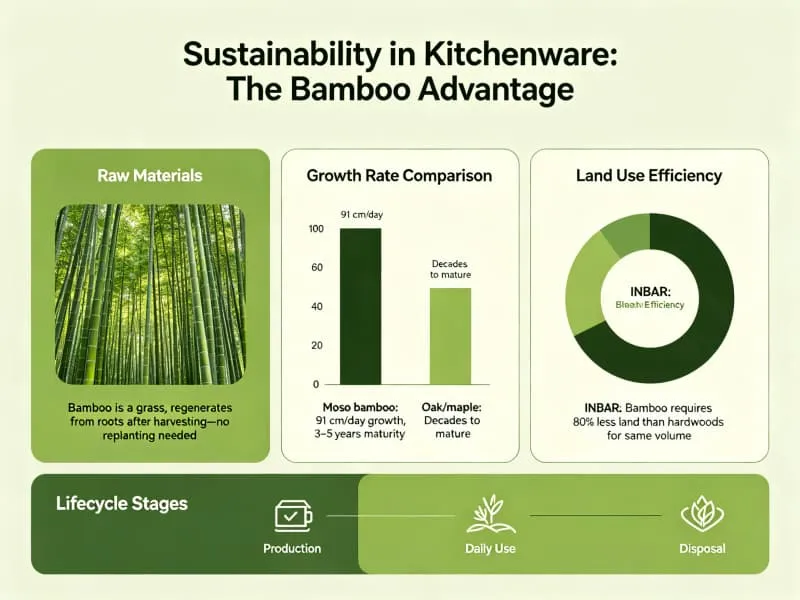
Sustainability in kitchenware isn't just a buzzword-it's something you can actually measure across a product's full lifecycle¹, from raw materials to production, daily use, and disposal. When you look at the whole picture, bamboo clearly stands out compared to other common cutting board materials.
One big reason is how fast bamboo grows. Unlike trees, bamboo is a grass that regenerates from its roots after harvesting-no replanting needed. Species like Moso bamboo², widely used in cutting boards, can grow up to 91 cm per day and reach maturity in just 3–5 years. In comparison, hardwoods like oak or maple can take decades to reach the same stage. That means bamboo produces more usable material with far less land.
In fact, according to the International Bamboo and Rattan Organization (INBAR)³, bamboo requires about 80% less land than hardwoods to produce the same volume. In a world where land use and deforestation are major concerns, that kind of efficiency makes a real difference.
How Does Bamboo's Carbon Footprint Compare?
Carbon footprint⁴ is another area where bamboo performs especially well. Managed bamboo forests can absorb around 5–12 tonnes of CO₂ per hectare each year, based on research published in Climate (MDPI, 2023)⁵-on par with, or even better than, many fast-growing tree plantations.
What's more, that carbon doesn't just disappear after harvesting. It stays stored in the bamboo itself, meaning every cutting board continues to hold a small amount of captured carbon throughout its life.
Plastic cutting boards tell a very different story. They're made from petroleum, which releases carbon during production, and most end up in landfills or incinerators-adding even more emissions at the end of their life cycle.
Initiatives like the UNFCCC BambooBoost Initiative⁷ highlight bamboo products as a practical way to support climate goals. Choosing a bamboo cutting board might seem like a small step, but at scale, these everyday decisions do add up.

| Material | Raw Material Renewability | Carbon Impact | Biodegradable | Avg. Lifespan | End-of-Life Disposal |
|---|---|---|---|---|---|
| Moso Bamboo | 3–5 years | Carbon positive (sequesters CO₂) | Yes - fully | 5–10 years | Compostable |
| Oak / Maple | 40–70 years | Carbon neutral (stores CO₂) | Yes | 10–20 years | Compostable |
| Rubber Wood | 25–30 years | Near carbon neutral | Yes | 5–10 years | Compostable |
| Polypropylene (PP) | Non-renewable (petroleum) | Carbon negative (emits CO₂) | No | 2–3 years | Landfill / Incineration |
| Polyethylene (PE) | Non-renewable (petroleum) | Carbon negative | No | 2–3 years | Landfill / Incineration |
| Glass / Ceramic | Non-renewable (silica, minerals) | High embodied energy | Partial | Very long | Landfill |
Is Consumer Demand for Eco-Friendly Cutting Boards Actually Growing?
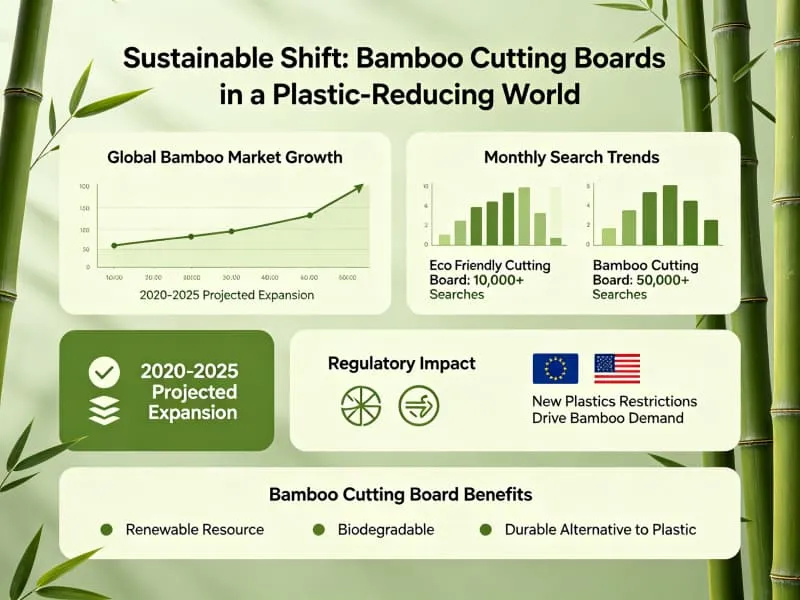
More people today are trying to reduce plastic use and choose more sustainable products, and that shift is showing up directly in buying behavior. Bamboo products, including cutting boards, are growing steadily as a result. The global bamboo market is expected to keep expanding over the next few years, which shows this isn't just a short-term trend.
You can see the same pattern in search data. Thousands of people search for terms like "eco friendly cutting board" every month, while "bamboo cutting board" gets tens of thousands of searches. That means people aren't just curious-they're actively looking for these products.
At the same time, new regulations in places like Europe and North America are starting to limit plastic use and encourage more sustainable materials. This is making bamboo an even more attractive option.
Put simply, demand for eco-friendly cutting boards is growing fast-and bamboo is one of the biggest winners.
What Role Does Bamboo Play in Reducing Kitchen Plastic Waste?
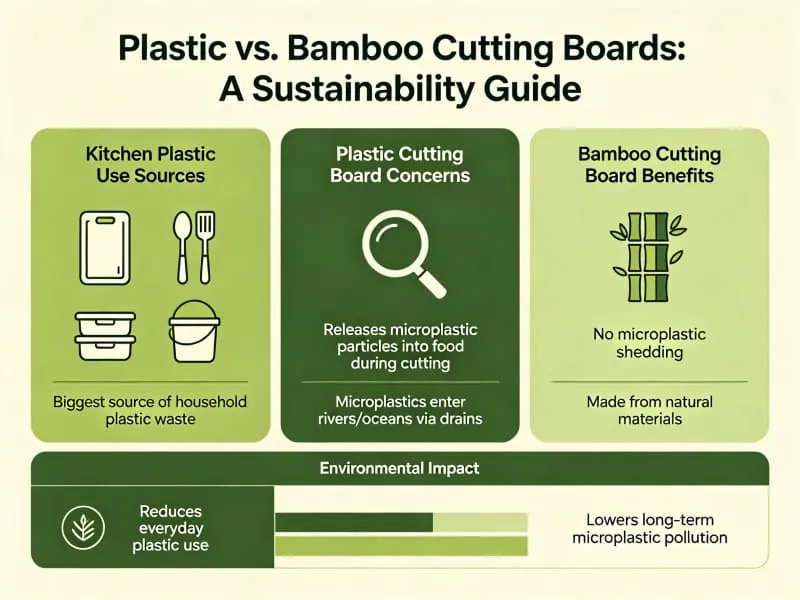
The kitchen is one of the biggest sources of plastic use in any home. From cutting boards to utensils and containers, these everyday items add up quickly-making up a large share of household plastic waste.
Switching from plastic cutting boards to bamboo is a simple but impactful change. It reduces plastic waste not only when you throw the board away, but also while you're actually using it.
Research shows that plastic cutting boards can release tiny microplastic⁰ particles into food during cutting. Over time, this can add up to a surprisingly large amount. Bamboo cutting boards don't have this issue-they're made from natural material and don't shed microplastics at all.
There's also a bigger picture. Microplastics from daily use don't just disappear-they can wash down drains and end up in rivers and oceans. By choosing bamboo instead of plastic, you're cutting down on that flow in a small but meaningful way.
In short, switching to a bamboo cutting board is an easy step that reduces both everyday plastic use and long-term environmental impact.
How Are Leading Kitchenware Brands Responding to the Eco-Kitchen Trend?
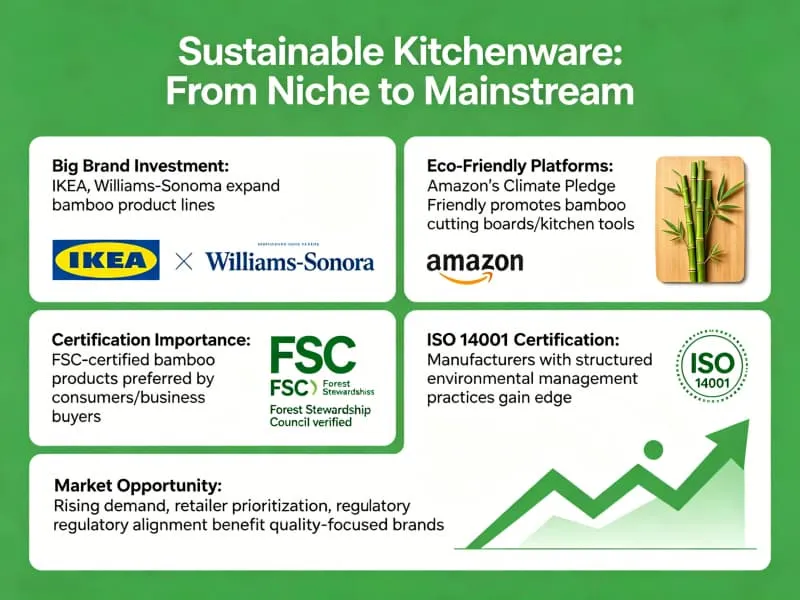
Sustainable kitchenware is no longer just a niche-it's something big brands are actively investing in.
Major retailers like IKEA and Williams-Sonoma have noticeably expanded their bamboo product lines in recent years. Even large platforms like Amazon are promoting eco-friendly options through programs like Climate Pledge Friendly, where bamboo cutting boards and kitchen tools feature heavily.
At the same time, certifications are becoming more important in buying decisions. FSC-certified¹² bamboo products-verified by the Forest Stewardship Council-are now widely preferred by both consumers and business buyers who care about responsible sourcing. Similarly, manufacturers with ISO 14001¹³ certification are gaining an edge, as they've proven they follow structured environmental management practices.
For brands and suppliers, this shift creates real opportunity. Demand is rising, retailers are prioritizing sustainable products, and regulations are moving in the same direction. Companies that focus on quality, certification, and reliable supply chains now are in a strong position to grow with the market in the years ahead.
Five Long-Tail Applications Driving Eco-Kitchen Bamboo Demand
These fast-growing product types show how bamboo cutting boards are being used in more practical, everyday ways:
Personalized bamboo cutting board - Custom-engraved boards for weddings, housewarmings, and corporate gifts, combining sustainability with a premium, personal touch
Large bamboo cutting board for meal prep - Oversized boards (45×35 cm+) designed for batch cooking, helping households rely less on packaged foods
Bamboo cutting board set with multiple sizes - Multi-board sets that support safe food separation, reducing the need for disposable barriers
Non-toxic bamboo cutting board for families - Made with food-safe adhesives and natural materials, ideal for households looking to avoid plastic contact with food
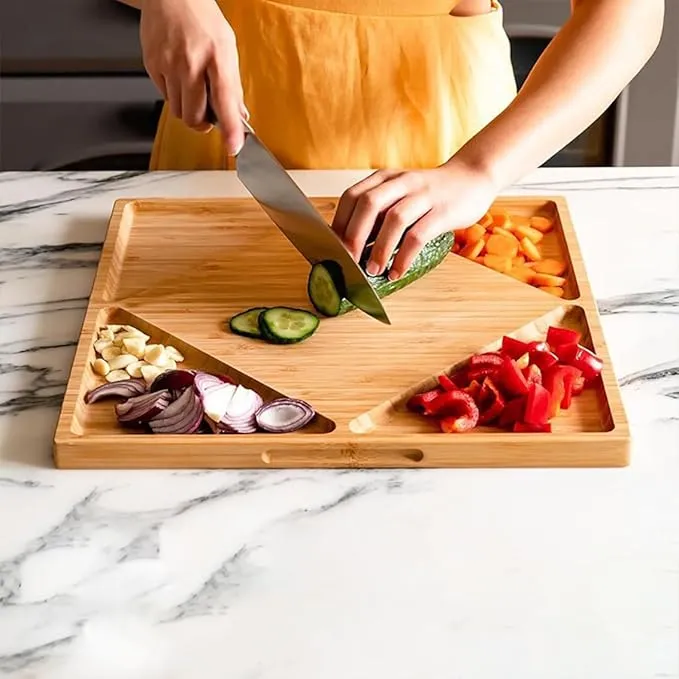
Bamboo chopping board with juice groove - Practical designs that catch liquids during prep and double as serving boards, cutting down on extra kitchen items
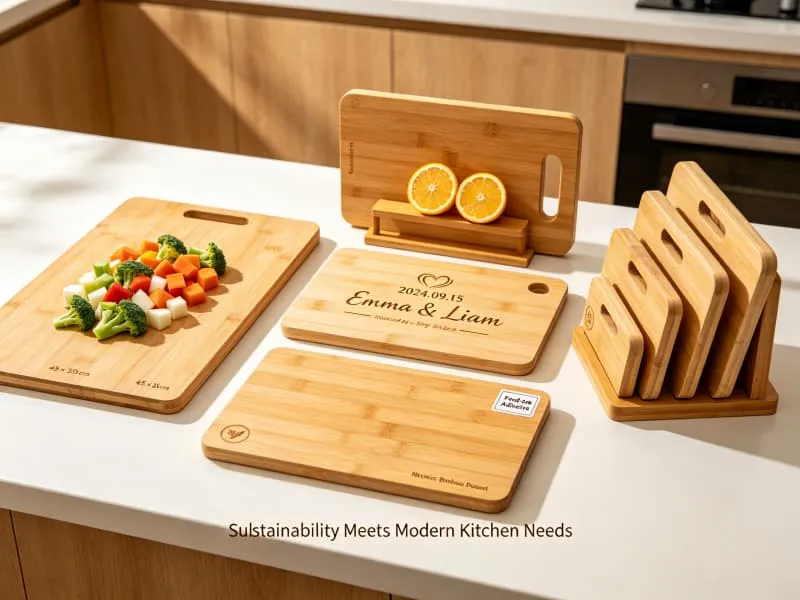
Together, these use cases reflect a bigger shift: people aren't just buying bamboo for sustainability-they're choosing it because it fits better into how modern kitchens work.
| Certification | What It Covers | Issuing Body | Why It Matters |
|---|---|---|---|
| FSC (Forest Stewardship Council) | Responsible land management and harvest | FSC International | Ensures bamboo is not contributing to land degradation |
| CARB Phase 2 | Formaldehyde emission limits | California Air Resources Board | Protects against toxic off-gassing in composite boards |
| EU Regulation 10/2011 | Food-contact plastic & material safety | European Commission | Required for legal sale in EU markets |
| FDA 21 CFR | Food-contact material safety | US Food and Drug Administration | Required for legal sale in US markets |
| ISO 14001 | Environmental management systems | ISO / Third-party auditors | Verifies manufacturer-level environmental responsibility |
| OEKO-TEX® STANDARD 100 | Harmful substance testing in textiles/materials | OEKO-TEX Association | Relevant for bamboo fiber products and board coatings |
What Is the Future Outlook for Bamboo Cutting Boards in Global Kitchens?
The outlook is very clear: bamboo cutting boards are only going to become more common.
Several trends are all moving in the same direction. More consumers are choosing sustainable products, governments are tightening rules on plastics, and awareness of environmental impact is growing. All of this makes bamboo a natural fit-it's renewable, durable, free from microplastics, and visually appealing.
Organizations like the United Nations Environment Programme have already highlighted bamboo as a key material for a low-carbon, circular economy¹⁶. And kitchen products-especially cutting boards-are one of the easiest ways for consumers to adopt it in everyday life.
For businesses and buyers, the real question now isn't if bamboo will become a standard in eco-friendly kitchens-it's how fast that shift will happen, and who will be ahead of it.
The Bamboo Kitchen: From Trend to Standard
Bamboo cutting boards have moved well beyond being a niche eco option-they're now a practical, everyday choice backed by real advantages. Compared to plastic, they offer better long-term hygiene; compared to hardwood, they're far more sustainable; and unlike glass, they're much kinder to your knives.
They store carbon instead of releasing it, break down naturally instead of sitting in landfills, and with proper care, they stay reliable for years. If you're aiming for a truly eco-friendly kitchen, bamboo isn't just one option-it's the one that makes the most sense.
Join the Eco-Kitchen Movement - Explore Our Bamboo Collection
The future of sustainable cooking starts with the tools you use every day. Whether you're upgrading your home kitchen, sourcing products for retail, or building a more sustainable hospitality brand, we offer a full range of certified bamboo cutting boards-from compact prep boards to extra-large professional sizes, as well as standard sets and custom-engraved options.
👉 Browse our complete Eco-Friendly Bamboo Cutting Board Collection-FSC-sourced, food-safe certified, and available for wholesale.
👉 Request a custom OEM/ODM quote-we support retailers, distributors, gifting brands, and food-service businesses across Europe, North America, Australia, and Asia.
Our address
No. 3, Wuyi 3rd Road, Jian'ou City, Nanping City, Fujian Province, 353100
Phone Number
+86 158 8924 9154
sales02@szmsl68.com

FAQ
Q1: Are bamboo cutting boards really more eco-friendly than wooden ones?
A: Yes, based on most quantifiable metrics, this is indeed the case. Bamboo matures in just 3 to 5 years, whereas hardwood takes 40 to 70 years; bamboo requires significantly less land per unit of production and continues to sequester carbon throughout its entire growth cycle.
Q2: How can I tell if a bamboo cutting board is truly eco-friendly or merely engaging in "greenwashing"?
A: Look for relevant third-party certifications: FSC certification confirms that the raw materials were sourced responsibly; compliance with CARB Phase 2 standards indicates extremely low formaldehyde emissions; while food contact safety certifications (such as the EU's Regulation (EU) No 10/2011 or the U.S. FDA's 21 CFR standards) ensure the cutting board is safe for use in the kitchen. Brands that publicly display these certifications have passed independent third-party audits; those that rely solely on vague slogans like "natural" or "eco-friendly" without providing specific certifications have clearly not undergone such rigorous verification.
Q3: Can bamboo cutting boards biodegrade naturally at the end of their useful life?
A: Yes. As long as they do not contain synthetic coatings, bamboo cutting boards are fully compostable at the end of their useful life. In an industrial composting environment, it typically takes only a few months to decompose; if placed in a home garden compost pile, it takes 1 to 2 years to fully decompose, leaving no persistent residues behind. This stands in stark contrast to plastic cutting boards-which ultimately break down into microplastic particles and persist in the environment for hundreds of years.
Annotations & Footnotes
¹ Product lifecycle - The complete sequence of stages from raw material extraction, manufacturing, distribution, consumer use, and end-of-life disposal. Lifecycle Assessment (LCA) is the standard methodology for evaluating total environmental impact across all stages.
² Phyllostachys edulis (Moso bamboo) - The most widely cultivated bamboo species globally, native to subtropical China. It accounts for approximately 70% of commercial bamboo product manufacturing, including cutting boards, flooring, and textiles, due to its exceptional growth rate, culm density, and workability.
³ INBAR (International Bamboo and Rattan Organization) - An intergovernmental organization with 49 member states, headquartered in Beijing, dedicated to promoting bamboo and rattan as tools for sustainable development and climate change mitigation. INBAR is the primary global authority on bamboo resource data.
⁴ Carbon footprint - The total greenhouse gas emissions (expressed as CO₂ equivalent) associated with a product, activity, or organization across its full lifecycle. Measured in kg CO₂e per unit of product.
⁵ MDPI Climate (2023) - Peer-reviewed open-access journal published by MDPI; the referenced study (DOI: 10.3390/cli11090175) provides a systematic review of bamboo carbon sequestration potential across biomass, products, and carbon credits.
⁶ Bamboo culm - The hollow, segmented aerial stem of a bamboo plant; the primary structural component harvested for industrial and consumer product manufacturing.
⁷ UNFCCC BambooBoost Initiative - A multi-partner climate initiative operating under the United Nations Framework Convention on Climate Change, designed to scale bamboo-based climate solutions and integrate bamboo into Nationally Determined Contributions (NDCs) under the Paris Agreement.
⁸ CAGR (Compound Annual Growth Rate) - A standardized measure of the mean annual growth rate of an investment, market, or metric over a specified period, assuming compounding. Used in market research to express sector growth trajectories.
⁹ EU Single-Use Plastics Directive (SUPD) - European Union Directive 2019/904, which entered into force in July 2021, banning or restricting a range of single-use plastic items and mandating extended producer responsibility for plastic packaging. It has directly accelerated demand for bio-based alternatives including bamboo kitchenware.
¹⁰ Microplastic - Plastic particles smaller than 5mm in their longest dimension; generated by mechanical degradation of plastic products during use. Confirmed as a contaminant in human blood, lung tissue, placenta, and fecal matter. Classified by WHO as an emerging concern for human health.
¹¹ UNEP (2023) - United Nations Environment Programme report on global plastic pollution; estimates 8–14 million tonnes of plastic enter oceans annually, with kitchen and household plastic waste representing a significant upstream source.
¹² FSC (Forest Stewardship Council) - An international non-profit organization established in 1993 that develops and maintains standards for responsible forest and land management. FSC certification is recognized as the most credible global standard for sustainable wood and bamboo sourcing.
¹³ ISO 14001 - An internationally recognized standard for Environmental Management Systems (EMS) issued by the International Organization for Standardization. Certification demonstrates that an organization systematically identifies, manages, monitors, and continuously improves its environmental performance.
¹⁴ Greenwashing - The practice of making misleading or unsubstantiated environmental claims about a product, service, or company policy to capitalize on consumer demand for sustainable products without implementing genuine sustainability practices.
¹⁵ CARB Phase 2 - Standards set by the California Air Resources Board limiting formaldehyde emissions from composite wood products (including bamboo boards using adhesive bonding). Phase 2 limits are among the most stringent in the world and are referenced globally as a benchmark for product safety in this category.
¹⁶ UNEP on bamboo in circular economy - Referenced from UNEP's published resources on nature-based solutions and green economy transitions, available at unep.org.
Authoritative Reference Links
UNEP - Bamboo as a Nature-Based Climate Solution https://www.unep.org/resources/newsletter/what-can-investments-do-bamboo-nature-based-solutions-leading-way-forward
UNFCCC - BambooBoost Initiative https://unfccc.int/bambooboost
MDPI Climate - Bamboo as a Nature-Based Solution for Climate Mitigation (2023) https://www.mdpi.com/2225-1154/11/9/175
FSC International - Certification Standards https://fsc.org/en/standards
PubMed - Plastic Cutting Boards as a Source of Microplastics in Meat (2022) https://pubmed.ncbi.nlm.nih.gov/35084287/
PMC (NIH) - Microplastic Release from Cutting Boards & Gut Health (2025) https://pmc.ncbi.nlm.nih.gov/articles/PMC11980920/