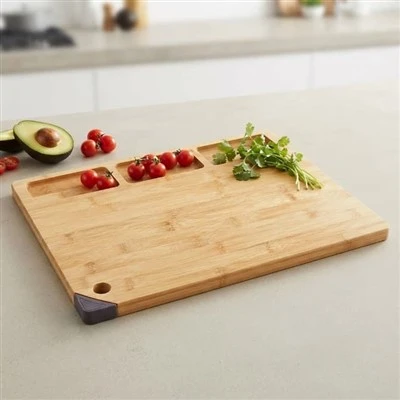









Meta Description: Discover why bamboo cutting boards are ideal for BBQ prep, from meat safety and juice groove performance to large-format sizing, serving versatility, and easy maintenance for outdoor grilling.
Bamboo Boards Are the Smartest Surface Choice for Serious BBQ Preparation
Bamboo boards for BBQ prep offer a unique balance of durability, food safety, heat resistance, and serving versatility that few other materials can match at a comparable price point. Whether you're trimming a full brisket, butterflying a leg of lamb, spatchcocking¹ a whole chicken, or slicing rested ribs, the cutting surface you choose directly impacts knife control, hygiene, workflow, and final presentation.
This guide explores everything serious grillers need to know about selecting, using, and maintaining the right bamboo cutting board for every stage of BBQ preparation and serving.
Why Do Serious Grillers Choose Bamboo Boards Over Other Materials?
BBQ preparation places far greater demands on a cutting board than everyday kitchen cooking. Large cuts such as briskets, pork shoulders, full rib racks, and whole chickens require a board with substantial surface area, solid stability, and the durability to handle extended heavy knife work. BBQ prep also involves acidic marinades², salty dry rubs, and enzymatic tenderizers³ that can stress lower-quality materials over time. Once the meat is cooked, slicing and resting large proteins releases significant amounts of juice that must be properly contained to keep prep areas clean.
Bamboo cutting boards are particularly well suited to these conditions. Compared with hardwood options like walnut, maple, or teak, bamboo offers similar durability and food-safe performance at a much more accessible price point, while also being lighter and easier to move between indoor kitchens and outdoor grilling stations. Plastic boards large enough for BBQ prep tend to develop deep knife grooves quickly, creating long-term hygiene concerns when handling raw meat and poultry. Glass and ceramic boards, meanwhile, are impractical for serious grilling because they rapidly dull knife edges and provide no effective juice control.

For BBQ use, a large bamboo cutting board measuring at least 50 × 38 cm and 30–45 mm thick offers the most practical balance of workspace, stability, and durability. Features such as integrated juice grooves⁴ and edge grain⁵ or end grain⁶ construction further improve performance during trimming, carving, and serving-making bamboo an ideal long-term solution for serious outdoor cooking and barbecue preparation.
What Size Bamboo Board Is Right for BBQ Preparation?
Choosing the right size is one of the most important decisions when setting up a BBQ prep station. A board that works well for everyday cooking is often far too small for full-scale barbecue preparation. Large cuts such as whole briskets, full rib racks, and spatchcocked chickens require enough surface area for safe handling, stable knife work, and clean presentation.
A full packer brisket can measure 55–70 cm in length before trimming, while St. Louis-style ribs commonly span 40–50 cm. Even a spatchcocked chicken can spread across most standard kitchen boards. When the board is too small, the meat must be constantly repositioned during cutting, increasing the risk of slipping, uneven slicing, and countertop contamination.

For serious BBQ prep, the practical minimum size is generally 50 × 38 cm, with a thickness of at least 30 mm. This provides enough working space for most common BBQ cuts while maintaining stability during trimming and carving.
For competition BBQ, catering, or larger households cooking for groups, an extra-large bamboo cutting board in the range of 60 × 45 cm or larger is a more suitable choice. The additional workspace improves efficiency when handling multiple proteins or large-format cuts simultaneously.
Thickness also plays an important role. A heavier board in the 38–45 mm range offers greater mass and rigidity, helping it stay stable during heavy-pressure cuts such as brisket trimming or breaking down primal⁷ cuts before cooking. Combined with non-slip rubber feet, a thick bamboo board remains firmly in place, improving both safety and knife control throughout the prep process.
| BBQ Cut | Typical Dimensions (raw) | Min. Board Size | Recommended Board Size | Thickness |
|---|---|---|---|---|
| Whole packer brisket | 55–70cm length | 60x40cm | 65x45cm | 38–45mm |
| Full rack spare ribs | 40–50cm length | 45x35cm | 50x40cm | 30–38mm |
| Bone-in pork shoulder | 25–35cm diameter | 40x35cm | 50x38cm | 30–38mm |
| Spatchcocked whole chicken | 40–45cm spread | 45x35cm | 50x38cm | 25–30mm |
| Rack of lamb | 30–40cm length | 38x30cm | 45x35cm | 25–30mm |
| Whole side salmon | 50–60cm length | 55x35cm | 60x40cm | 25–30mm |
| Tri-tip / picanha | 25–35cm length | 35x28cm | 45x35cm | 25–30mm |
Does a Bamboo Board With Juice Groove Perform Better for BBQ?
For BBQ preparation, a bamboo cutting board with a juice groove is far more than a convenience feature-it is an essential part of an efficient and hygienic prep setup. Large cuts such as brisket, ribs, and pork shoulder release a significant amount of liquid during resting and carving. A rested whole brisket, for example, can release hundreds of milliliters of juice and rendered fat during slicing.
Without proper juice management, these liquids can quickly spill across the countertop, creating mess, contamination risks, and difficult cleanup.
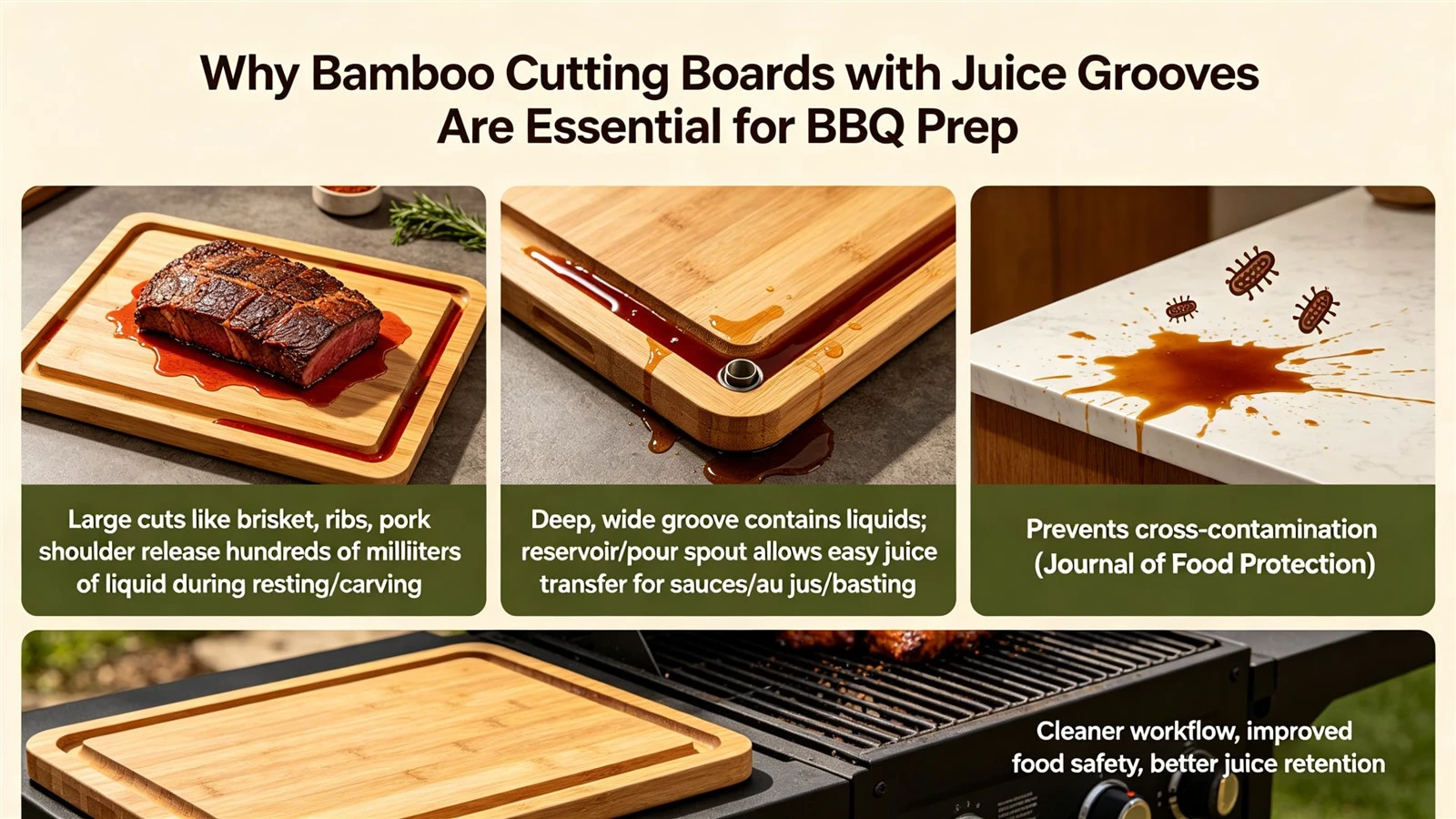
A well-designed juice groove helps contain and direct this liquid away from the cutting surface. For effective BBQ use, the groove should be deep and wide enough to handle high juice volume, ideally extending around the perimeter of the board. Premium designs may also include a corner reservoir or pour spout, allowing collected juices to be easily transferred for use in sauces, au jus⁹, or basting.
Beyond convenience, juice grooves also contribute to better kitchen hygiene. Research published in the Journal of Food Protection identifies liquid overflow during meat carving as a common contributor to cross-contamination¹⁰ in both home and commercial kitchens. While a groove cannot replace proper food handling or board sanitization, it does help limit the spread of raw or resting-protein juices across surrounding surfaces.
For serious grillers, this combination of cleaner workflow, improved food safety, and better juice retention makes a quality bamboo board with an integrated groove one of the most practical tools in any BBQ setup.
Is Bamboo Safe for Marinated Meat and BBQ Rub Chemistry?
This is a question serious BBQ practitioners genuinely ask - and it deserves a more precise answer than the generic claim that "bamboo is food safe." BBQ marinades and dry rubs create a far more aggressive chemical environment than ordinary food preparation. Acidic marinades containing citrus juice (pH 2.0–3.5), wine or beer (pH 3.0–4.5), and vinegar (pH 2.5–3.5) can gradually attack both the bamboo fiber surface and the adhesive bonds between bamboo strips if the board is not properly maintained and sealed with food-grade mineral oil¹¹.
A properly maintained bamboo cutting board - ideally treated monthly with food-grade mineral oil to preserve surface density - is highly resistant to acidic marinade penetration. The oil-conditioned surface forms a moisture barrier that reduces acid exposure to the bamboo fiber matrix, helping prevent surface softening and adhesive deterioration that are more likely to occur on dry, untreated boards.
Even so, marinated meat should never remain on a bamboo board for extended periods. Best practice is to use the board as a preparation surface for trimming and seasoning, then transfer the meat to a non-reactive container such as stainless steel, glass, or food-grade plastic for the actual marination process.

High-sodium dry rubs introduce another important variable. Competition-style BBQ rubs commonly contain salt concentrations of 50–80%, and salt is highly hygroscopic¹² - meaning it actively draws moisture from surrounding materials. Prolonged exposure can pull moisture from bamboo fibers through osmotic action, accelerating surface drying and increasing the risk of micro-cracking over time.
The practical recommendation remains the same: use the bamboo board for seasoning and handling proteins, but avoid leaving heavily salted cuts resting on the surface for extended periods. After use, wash the board promptly, dry it thoroughly, and reapply mineral oil regularly to maintain long-term durability and performance.
How Should a Bamboo BBQ Board Be Cleaned After Raw Meat Use?
Post-BBQ board cleaning is where food safety principles collide with real-world kitchen habits - and the gap between recommended sanitation practices and what most backyard grillers actually do is surprisingly large. The WHO's Five Keys to Safer Food¹³ identifies contaminated cutting board surfaces as a major transmission route for Salmonella, Campylobacter, and E. coli O157:H7¹⁴ in domestic kitchens - three pathogens commonly associated with raw BBQ proteins.
The proper post-use cleaning protocol for a bamboo cutting board used in raw meat BBQ preparation is straightforward but important. Immediately after use, scrape away loose debris with a bench scraper. Wash the board within 30 minutes using hot water (comfortably hot to the touch), a dedicated cleaning brush, and a food-grade dish soap. Extra attention should be given to the juice groove, where protein residue and raw meat fluids can accumulate beyond the reach of routine surface washing. Rinse thoroughly with hot water, dry all surfaces immediately with a clean cloth, and then stand the board upright to complete air-drying.

For boards used specifically with raw poultry - where Campylobacter contamination risk is particularly high - an additional sanitization step is advisable. After washing, apply a 3% hydrogen peroxide¹⁵ spray, allow it to remain on the surface for approximately 90 seconds, then rinse and dry thoroughly. This two-step process (soap cleaning followed by hydrogen peroxide sanitization) can achieve pathogen reduction levels comparable to commercial food-service sanitation standards.
Bleach should never be used on a bamboo cutting board. Chlorine-based cleaners gradually degrade the lignin¹⁶ structure that gives bamboo fibers their strength, weaken adhesive bonding between bamboo strips, and may leave undesirable chemical residues on a food-contact surface.
BBQ Prep Board Cleaning Protocol by Protein Type
| Protein Type | Primary Pathogen Risk | Wash Protocol | Sanitization Step | Frequency of Dedicated Sanitization |
|---|---|---|---|---|
| Whole chicken / poultry | Campylobacter, Salmonella | Hot water + brush + dish soap | 3% hydrogen peroxide, 90 sec | After every use |
| Raw beef (brisket, ribs) | E. coli O157:H7, Salmonella | Hot water + brush + dish soap | White vinegar 1:1, 2 min | After every raw use |
| Pork (shoulder, ribs) | Salmonella, Yersinia | Hot water + brush + dish soap | White vinegar 1:1, 2 min | After every raw use |
| Lamb | E. coli, Campylobacter | Hot water + brush + dish soap | 3% hydrogen peroxide, 90 sec | After every use |
| Whole fish / seafood | Vibrio, Listeria | Hot water + brush + dish soap | 3% hydrogen peroxide, 90 sec | After every use |
| Cooked proteins (slicing only) | Minimal (post-cook) | Hot water + brush + dish soap | Weekly vinegar sanitization | Weekly |
| Vegetables / sides | Minimal | Hot water + brush | Monthly | Monthly |
Does a Bamboo BBQ Board Work for Outdoor Serving and Presentation?
This is where bamboo cutting boards demonstrate an advantage that purely utilitarian alternatives simply cannot replicate: the balance of functional performance and visual warmth that has made them a preferred serving surface in premium BBQ restaurants, food-service environments, and backyard entertaining setups around the world.
A large bamboo cutting board - particularly one featuring figured edge-grain or patterned end-grain construction - loaded with sliced brisket, pulled pork, ribs, and sides delivers a natural, rustic presentation that stainless steel, plastic, or ceramic serving ware rarely matches.
From a practical outdoor serving perspective, bamboo also offers meaningful usability advantages. Its relatively light weight makes oversized serving boards far easier to transport from prep station to dining table. A 50 × 38 × 3.0 cm bamboo board typically weighs around 1.8–2.2 kg, substantially lighter than an equivalent granite or marble slab.

Bamboo's naturally warm surface - both visually and to the touch - also helps rested proteins retain ambient heat slightly longer than cold stone serving surfaces, offering a small but noticeable benefit during table service. Boards designed with a juice groove are especially valued in BBQ presentation, as they continue to capture meat juices released during tableside carving and serving.
For retail and wholesale buyers targeting the outdoor entertaining category, bamboo cutting boards occupy a particularly attractive commercial position. They are affordable enough for high-volume retail programs, visually premium enough for gifting and hospitality applications, and durable enough to encourage repeat purchase behavior.
The personalized bamboo cutting board segment - including laser-engraved names, logos, monograms, and BBQ-themed artwork - has become one of the fastest-growing categories within outdoor entertaining accessories, with demand rising sharply during the spring and summer grilling season.
What Maintenance Does a BBQ Bamboo Board Need Between Grilling Sessions?
BBQ environments create maintenance demands that standard kitchen cutting board guidelines often fail to address. Outdoor grilling setups expose boards to conditions far more variable than those found in indoor kitchens - including direct sunlight, elevated surface temperatures, lower ambient humidity during summer months, and rapid temperature fluctuations caused by proximity to the grill. Together, these factors accelerate moisture loss from bamboo fibers, increasing the likelihood of surface checking¹⁷, warping, and gradual loss of structural stability over time.

For bamboo cutting boards used regularly in BBQ applications, maintenance frequency should be higher than for boards used exclusively indoors. During active grilling season, apply food-grade mineral oil to all six surfaces every 3–4 weeks, rather than the typical 4–6 week interval recommended for standard kitchen use. After each BBQ session, inspect the board carefully for fresh knife grooves, early surface checking, or stress along adhesive joints. Identifying and addressing these issues early - through light sanding and re-oiling - helps prevent minor cosmetic wear from developing into permanent structural damage.
During off-season storage, keep the board flat or upright in a cool, dry environment away from direct sunlight and heat sources. Before storing it for extended periods, apply a generous conditioning coat of food-grade mineral oil or a beeswax–mineral oil blend to help stabilize moisture content throughout the bamboo fiber structure.
A board that enters winter storage properly conditioned - and emerges in spring still protected - can maintain both its structural integrity and hygienic performance across many years of heavy BBQ use, delivering a lifespan that few plastic cutting boards can realistically match.
The BBQ Board That Works As Hard As You Do
A bamboo cutting board built to true BBQ specification - oversized format, 38 mm+ thickness, integrated juice groove, edge-grain or end-grain construction, food-safe adhesive system, and a properly pre-oiled surface - is more than a kitchen accessory. It becomes part of the BBQ workflow itself: a reliable prep surface, carving station, serving platform, and presentation piece that performs consistently through every trimming session, cook day, and tableside service.
Maintain it correctly, and a quality bamboo BBQ board can outlast multiple grills, continuing to perform season after season with the same dependable function and visual character that serious BBQ enthusiasts value in every piece of their equipment.
Gear Up Your BBQ Station the Right Way
Upgrade your BBQ setup with a cutting board built for real grill work - not lightweight kitchen prep. Our bamboo BBQ cutting boards are crafted from certified mature Moso bamboo and designed for demanding outdoor cooking environments. Choose from large and extra-large sizes, deep juice groove designs, edge-grain or end-grain construction, and heavy-duty 30–45 mm thickness options engineered for brisket carving, rib prep, and full-service BBQ presentation.
Every board is manufactured with food-safe adhesives and compliant food-contact finishes, meeting the safety and quality requirements of major international markets. Durable enough for daily prep, refined enough for table-side serving, and customizable enough for retail branding and gifting programs.

Whether you're:
a backyard pitmaster upgrading your grilling station,
a BBQ caterer or restaurant operator,
or a retailer sourcing premium outdoor entertaining products,
we provide flexible solutions for both retail and wholesale supply.
👉 Discover our BBQ Bamboo Cutting Board collection - featuring oversized carving boards, juice groove models, butcher-block styles, and personalized laser-engraved options for seasonal retail and hospitality programs.
👉 Wholesale & OEM inquiries welcome. Send us your specifications, logo requirements, and target quantities - samples, certifications, and pricing support available within 24 hours.
FAQ
Q1: Can I use my bamboo BBQ board directly next to the grill - will the heat damage it?
A: Keep the board away from direct radiant heat from the grill - sustained temperatures above 60°C will dry out the bamboo fibers rapidly, causing surface checking and warping. Use it as your prep and carving surface away from the heat source, not as a heat-side trivet. If you need a heat-resistant surface next to the grill, a stainless steel tray is the right tool for that specific job.
Q2: How do I stop my bamboo BBQ board from sliding when I'm cutting a whole brisket?
A: First, make sure your board has non-slip rubber feet - if it doesn't, place a damp kitchen towel underneath. Second, upgrade to a 38–45mm thick board; the increased mass dramatically improves stability under heavy cutting pressure. Third, ensure the board is large enough that the cut is centered on the surface - a brisket hanging over the edge of an undersized board creates uneven pressure that causes movement.
Q3: Should I use a separate bamboo board for raw meat and cooked meat at a BBQ?
A: Absolutely yes - and this is one of the most important food safety practices for any BBQ cook. Raw poultry, beef, and pork carry pathogens (Salmonella, Campylobacter, E. coli) that must not contact cooked protein surfaces. A bamboo cutting board set with clearly differentiated boards for raw prep and post-cook carving is the single most effective cross-contamination control measure available to a backyard griller, endorsed by the WHO, FDA, and UK Food Standards Agency.
Annotations & Footnotes
¹ Spatchcocking - A butchery technique in which the backbone of a whole bird is removed and the bird is flattened by pressing down on the breastbone, enabling faster, more even cooking on a grill or in an oven. Requires a large, stable cutting surface and a sharp, heavy knife or dedicated poultry shears.
² Marinade - A seasoned liquid mixture - typically containing acid (citrus, vinegar, wine), fat (oil), and flavoring agents (herbs, spices, aromatics) - in which proteins are immersed before cooking to tenderize, flavor, and in some cases, provide surface protection against high-heat cooking. Acid content ranges from pH 2.0 to pH 4.5 in common BBQ marinade formulations.
³ Enzymatic tenderizers - Compounds containing protease enzymes - commonly papain (from papaya), bromelain (from pineapple), or ficin (from figs) - that partially break down muscle protein structures in raw meat to improve tenderness. Relevant to cutting board surface compatibility because active proteases can attack bamboo fiber surface chemistry with prolonged contact.
⁴ Juice groove - A channel routed around the perimeter (and sometimes across the surface) of a cutting board, designed to capture and contain the liquid released by resting or carving proteins. Optimal groove specifications for BBQ use: minimum 8mm depth, 12mm width, with a corner reservoir or pour spout for directed liquid collection.
⁵ Edge grain - A cutting board construction in which the narrow edge face of the bamboo strip faces upward as the working surface. Provides superior resistance to knife scoring compared to face grain construction, with better moisture management and dimensional stability under repeated use and cleaning cycles.
⁶ End grain - A cutting board construction in which the cut end of the bamboo culm faces upward. The blade enters between fibers rather than cutting across them, delivering maximum knife-edge preservation and a degree of surface self-healing after knife contact. The preferred specification for heavy BBQ prep use.
⁷ Primal cuts - The large primary divisions of a beef, pork, or lamb carcass produced during the initial butchery process before further portioning into sub-primal and retail cuts. Common BBQ primals include the brisket (beef pectoral), pork shoulder (Boston butt + picnic), and beef short plate (source of short ribs and skirt steak).
⁸ Resting period - The post-cook holding period during which a cooked protein is allowed to equilibrate temperature and redistribute internal moisture before carving. For large BBQ cuts, resting periods range from 30 minutes (chicken) to 2 hours (whole brisket); during this period, significant juice volume accumulates within the protein and is subsequently released during carving.
⁹ Au jus - A French culinary term meaning "with juice"; refers to the natural cooking juices collected from a rested protein, used as an accompanying sauce or dipping liquid. In BBQ contexts, brisket au jus - collected from the carving board during slicing - is a valued accompaniment that juice groove board designs facilitate efficiently.
¹⁰ Cross-contamination - The transfer of harmful microorganisms from raw food, surfaces, or equipment to cooked or ready-to-eat food. Identified by the WHO as a primary cause of foodborne illness in domestic and food-service environments; particularly significant in BBQ contexts where raw and cooked proteins are handled in close proximity.
¹¹ Food-grade mineral oil - A highly refined petroleum-derived oil approved by the FDA under 21 CFR 172.878 for food-contact applications. Applied to bamboo cutting board surfaces to fill fiber voids, resist moisture and acid penetration, and maintain surface density - the primary maintenance tool for preserving bamboo board integrity in BBQ environments.
¹² Hygroscopic - The property of a substance to absorb moisture from the surrounding environment through osmotic or adsorptive processes. High-concentration salt in BBQ dry rubs exerts a hygroscopic effect on bamboo fiber surfaces, drawing moisture out of the cell matrix with prolonged contact.
¹³ WHO Five Keys to Safer Food - The World Health Organization's globally adopted food safety framework, deployed in over 130 countries; Key 2 (separate raw and cooked) directly addresses cutting board cross-contamination in domestic and professional cooking environments and forms the scientific basis for color-coded board set recommendations.
¹⁴ E. coli O157:H7 - A particularly virulent strain of Enterohemorrhagic Escherichia coli (EHEC) associated with severe foodborne illness including hemorrhagic colitis and hemolytic uremic syndrome (HUS); a primary food safety concern in raw beef preparation, making surface hygiene and cross-contamination prevention critical in BBQ beef prep environments.
¹⁵ 3% hydrogen peroxide - A food-contact-safe oxidizing sanitizing agent providing broad-spectrum pathogen reduction against Salmonella, Campylobacter, E. coli, and Listeria monocytogenes; safe for bamboo surface application at 3% concentration when rinsed promptly after a 60–90 second contact time.
¹⁶ Lignin - A complex aromatic biopolymer forming a key structural component of bamboo cell walls; provides structural rigidity and is the source of bamboo's natural antimicrobial phenolic compounds. Bleach (sodium hypochlorite) oxidizes and degrades lignin, simultaneously weakening structural integrity and eliminating surface antibacterial activity.
¹⁷ Surface checking - Fine surface cracks or splits developing along the bamboo grain direction as a result of differential drying rates between outer and inner fiber layers. In outdoor BBQ environments with low humidity and direct sunlight exposure, checking can develop significantly faster than in standard indoor kitchen conditions if regular oiling is not maintained.
Authoritative Reference Links
WHO - Five Keys to Safer Food https://www.who.int/activities/promoting-safe-food-handling/five-key-to-safer-food
PubMed - Cutting Boards of Plastic and Wood Contaminated with Bacteria https://pubmed.ncbi.nlm.nih.gov/31113021/
PMC (NIH) - Antimicrobial Characteristics of Wood and Bamboo Materials https://pmc.ncbi.nlm.nih.gov/articles/PMC7277147/
PubMed - Plastic Cutting Boards as a Source of Microplastics in Meat (2022) https://pubmed.ncbi.nlm.nih.gov/35084287/
FSC International - Certification Standards https://fsc.org/en/standards
FDA - 21 CFR 172.878: Food-Grade Mineral Oil https://www.ecfr.gov/current/title-21/chapter-I/subchapter-B/part-172/subpart-H/section-172.878