



Meta Description: Bamboo cutting board vs glass board - a science-backed comparison covering knife damage, hygiene, durability, safety, and sustainability to help you make the right decision for your kitchen once and for all.
The Bamboo Cutting Board Wins Against Glass on Every Practical Kitchen Metric
A bamboo cutting board outperforms a glass board in knife protection, user safety, acoustic comfort, and environmental sustainability - and these advantages are measurable, not merely subjective. Glass boards remain popular because they photograph well, clean easily, and create a perception of clinical sterility. In real kitchen use, however, they quickly dull knife edges, create potential breakage hazards, produce harsh scraping noise during cutting, and offer little functional advantage over a properly maintained bamboo cutting board. This comparison examines the factors that truly matter in daily use, helping you choose with confidence based on performance rather than appearance.
Why Do People Still Buy Glass Cutting Boards?
Glass cutting boards have made their mark in the kitchenware market primarily due to three key advantages: First, their non-porous¹ surface effectively prevents bacteria from penetrating; second, they can be safely washed in the dishwasher without suffering structural damage; and finally, they feature a stylish and decorative design, serving not only as a cutting surface but also as a serving tray or heat-resistant mat.
However, in daily use, a bamboo cutting board, with its dense fiber structure and natural antibacterial properties, can achieve bacterial removal results comparable to those of a glass cutting board after washing, without causing the severe wear and tear to knives that a glass surface does. Furthermore, in modern kitchen design, bamboo's warm texture and natural grain are now widely regarded as a more refined and sophisticated choice than glass.
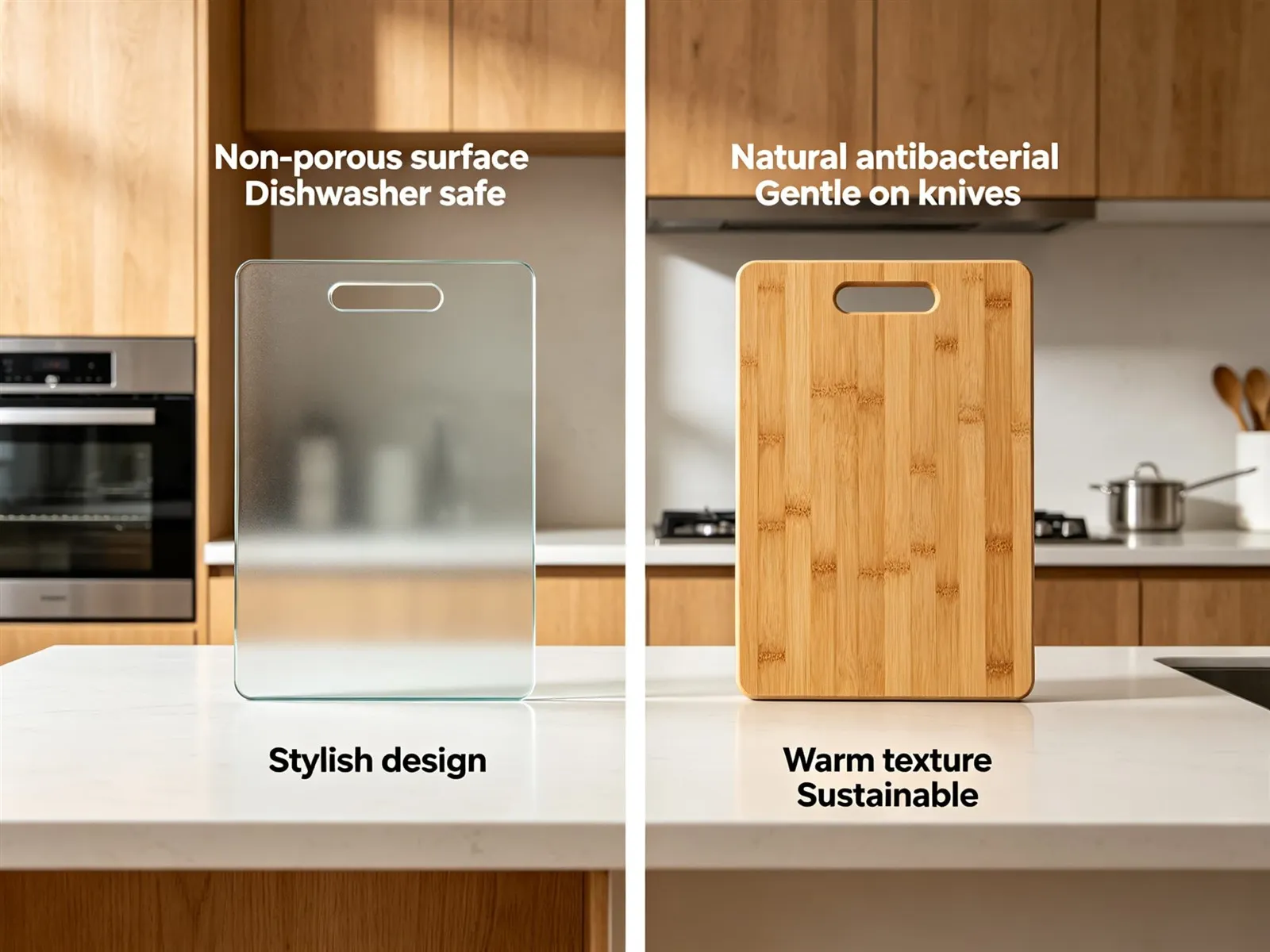
Glass cutting boards have not yet disappeared from the market because consumers prioritize cleanliness and hygiene, and glass happens to offer a simple, easy-to-clean solution. In contrast, bamboo cutting boards not only meet the hygiene standards required for daily meal preparation just as effectively, but also demonstrate significant advantages in many areas-including knife care, food safety, user comfort, and sustainability-whereas glass cutting boards often fail to address these issues and may even create new problems.
What Does a Glass Board Actually Do to Your Knife?
This is the central practical argument against glass cutting boards, and the science behind it is actually very straightforward: glass is harder than your knife edge.
During normal meal preparation, a kitchen knife blade - whether it is European high-carbon stainless steel² rated around 56–58 HRC³ on the Rockwell Hardness Scale, or harder Japanese high-carbon steel at 60–66 HRC - strikes the cutting surface thousands of times. Every one of those impacts affects the condition of the blade edge. The greater the hardness difference⁴ between the knife steel and the cutting surface, the faster the knife dulls.
Glass is extremely hard. Depending on its composition, it has a Mohs hardness⁵ of roughly 5.5–7.0 and a Vickers Hardness⁶ of around 400–700 HV. In practical terms, that makes glass harder than the edge steel used in most kitchen knives. Every time the blade contacts the surface, the glass removes microscopic amounts of steel from the blade apex⁷. Over time, this creates tiny chips, edge rolling, and rapid dulling that regular honing or stropping cannot fully repair. Eventually, the knife needs proper sharpening - and repeated sharpening gradually shortens the lifespan of the blade itself.
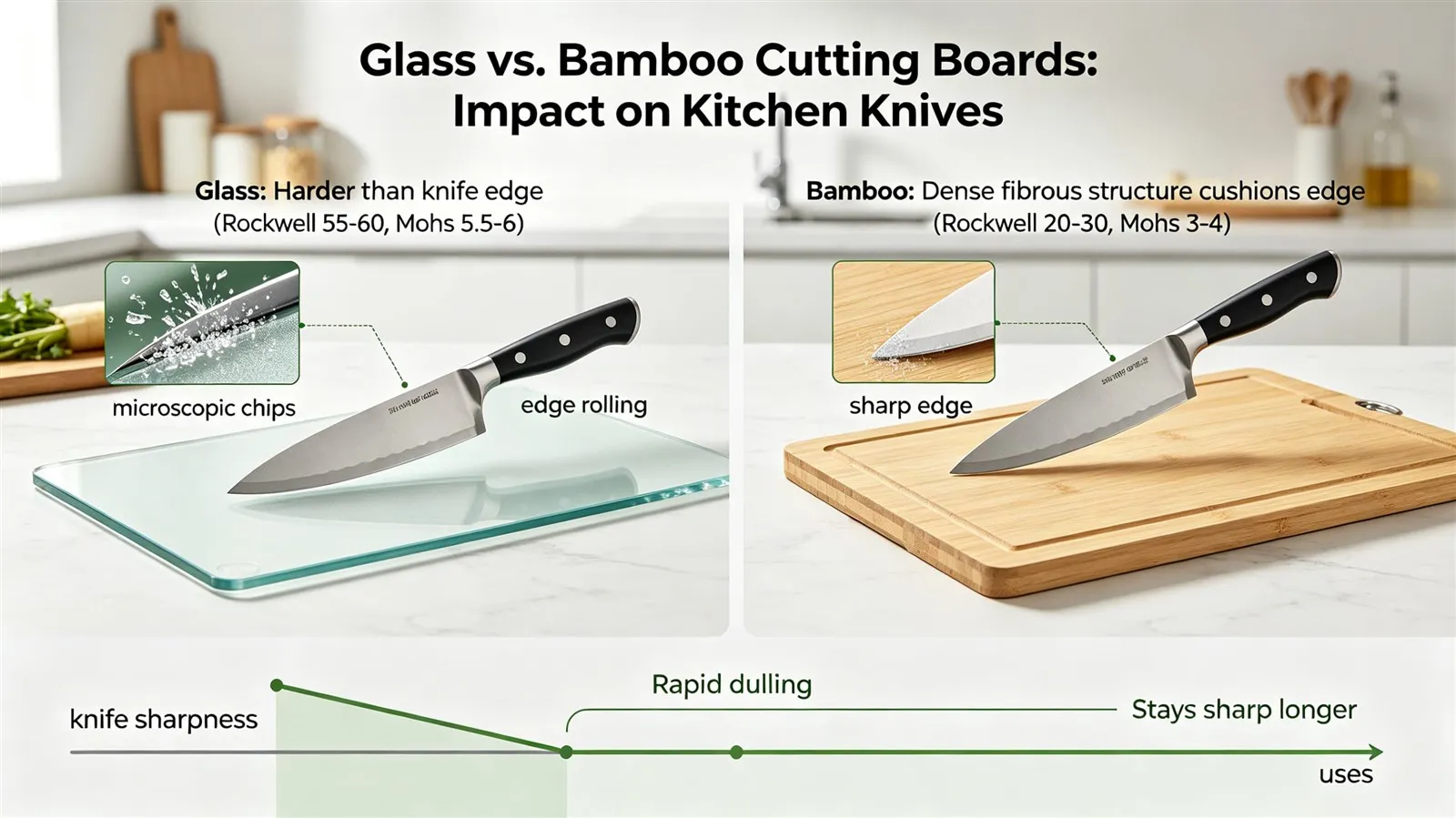
This is why many people notice their knives becoming dull much faster after using glass boards regularly.
A bamboo cutting board behaves very differently. Bamboo measures around 1,380 lbf on the Janka Hardness Scale⁸, which makes it genuinely durable compared to many softwoods and even some hardwoods. But unlike glass, bamboo has a dense fibrous structure that slightly cushions the knife edge during contact instead of grinding against it. Its hardness is strong and supportive rather than abrasive.
That difference explains the entire knife-damage debate in one simple idea: glass works against the knife edge, while bamboo works with it.
It is also why professional knife manufacturers - from Wüsthof to Shun to Global - consistently recommend wood or bamboo cutting surfaces and specifically warn against glass, ceramic, and stone boards for regular food preparation.
| Surface Material | Janka / Surface Hardness | Edge Abrasion Rate | Knife Damage Category | Professional Recommendation |
|---|---|---|---|---|
| Glass / Tempered Glass | ~600–700 HV (Vickers) | Extreme | Severe - destroys edges rapidly | Never recommended |
| Ceramic / Porcelain | ~700–900 HV | Extreme | Severe - worse than glass | Never recommended |
| Granite / Stone | ~600–800 HV | Extreme | Severe | Never recommended |
| Bamboo (face grain) | ~1,380 lbf (Janka) | Low–Moderate | Acceptable for most knives | Acceptable |
| Bamboo (edge grain) | ~1,380 lbf | Low | Good - preserves edge well | Recommended |
| Bamboo (end grain) | ~1,380 lbf | Very Low | Excellent - professional standard | Highly recommended |
| Hard Maple (end grain) | ~1,450 lbf | Very Low | Excellent | Gold standard |
| Walnut (end grain) | ~1,010 lbf | Minimal | Best for premium knives | Highly recommended |
| Plastic (HDPE) | ~1,500 surface hardness | Moderate | Poor - grooves damage edges over time | Acceptable short-term |
Is a Glass Board Actually More Hygienic Than Bamboo?
The hygiene argument for glass cutting boards deserves a closer look because it is probably the most common reason people choose glass over bamboo. And to be fair, part of the argument is true: glass is genuinely non-porous, which means liquids and bacteria cannot soak into the material itself. A glass board cleaned in a dishwasher at around 75°C with detergent can reach an extremely high level of surface sanitation - higher than most cutting board materials can tolerate under the same conditions.
But that advantage only lasts while the surface stays smooth.
Unlike bamboo or wood, glass does not absorb the impact of a knife blade at all. Instead, the knife repeatedly strikes the hard surface directly. Over time, this leaves fine scratches across the board. After many cutting sessions, those scratches build up into tiny grooves where moisture, food particles, and bacteria can collect - very similar to what happens with heavily used plastic cutting boards.
In other words, glass starts perfectly smooth, but regular knife use slowly damages that smooth surface.
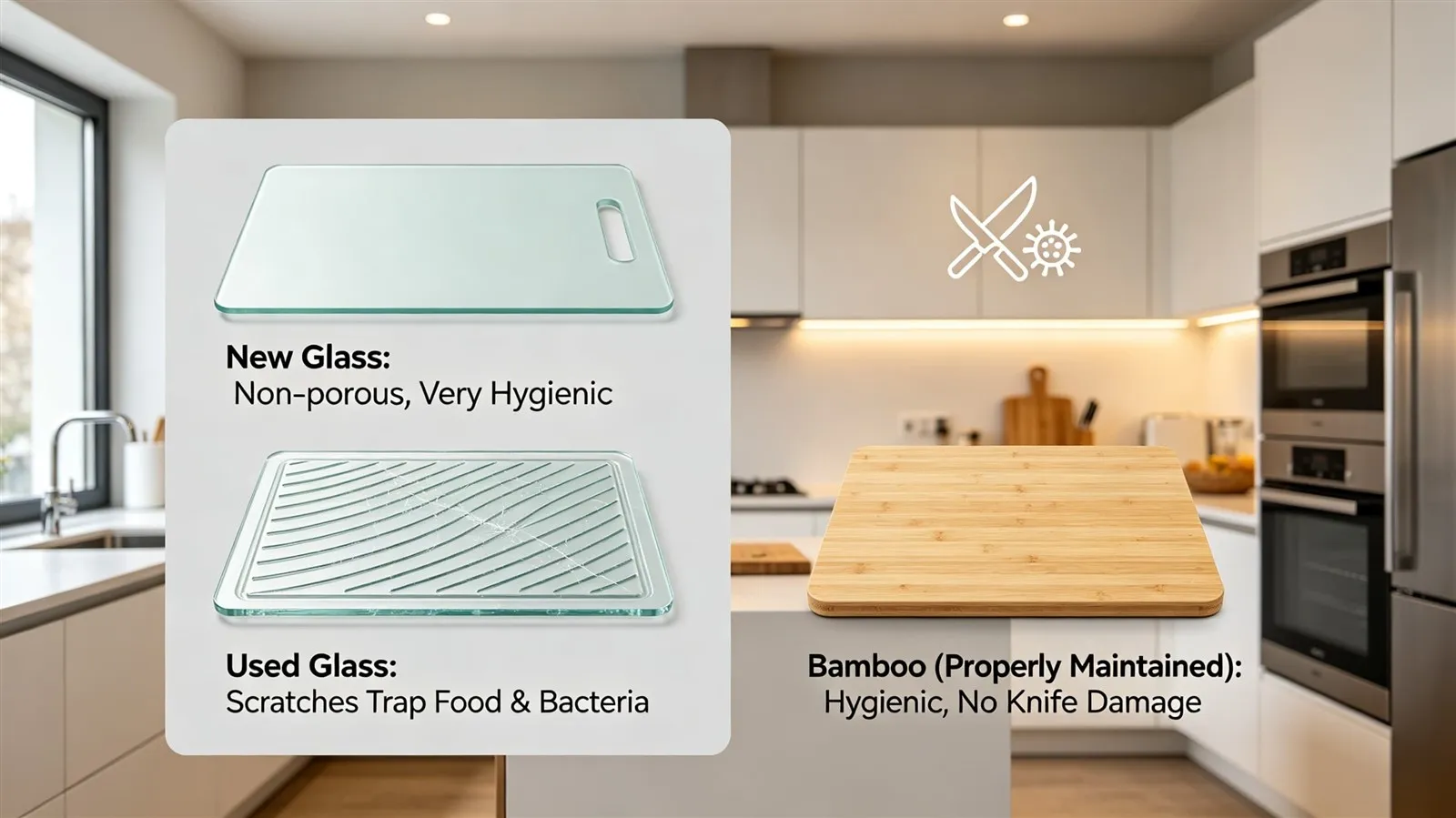
This is important because hygiene is not just about the material itself - it is also about the condition of the surface. Even the FDA recommends replacing cutting boards with heavy scoring or deep grooves, regardless of the material. That principle applies to scratched glass boards just as much as it applies to plastic ones.
Research published in the Journal of Food Protection⁹ found that heavily scratched glass surfaces did not show significantly lower bacterial survival than comparable hardwood surfaces after normal hand-washing. That suggests glass does not have an automatic hygiene advantage forever. Its performance depends heavily on how scratched the surface becomes and how the board is cleaned.
A well-maintained bamboo cutting board can also perform extremely well in real kitchens. Regular mineral oil conditioning and occasional sanitizing with 3% hydrogen peroxide¹⁰ help maintain the surface and reduce bacterial survival after washing to levels that are highly effective for normal food preparation. In practical everyday use, bamboo can provide cleanliness very close to glass - without the severe knife damage that glass surfaces cause over time.
Does a Glass Board Present Physical Safety Risks?
Glass cutting boards also come with two practical safety issues that bamboo boards simply do not have, and both are worth considering in a realistic kitchen comparison.
The first is breakage risk. Most glass cutting boards are made from tempered glass¹¹, which is designed to break into small blunt pieces instead of dangerous sharp shards. That makes it safer than ordinary glass, but it does not make it unbreakable. If a glass board slips off the counter, falls onto a tile floor, or gets hit by a heavy pot or pan, it can shatter completely. When that happens, the problem is not just replacing the board - it also creates a messy and stressful cleanup situation involving tiny glass fragments around food preparation areas.
For many home kitchens, that alone is enough reason to avoid glass boards entirely.
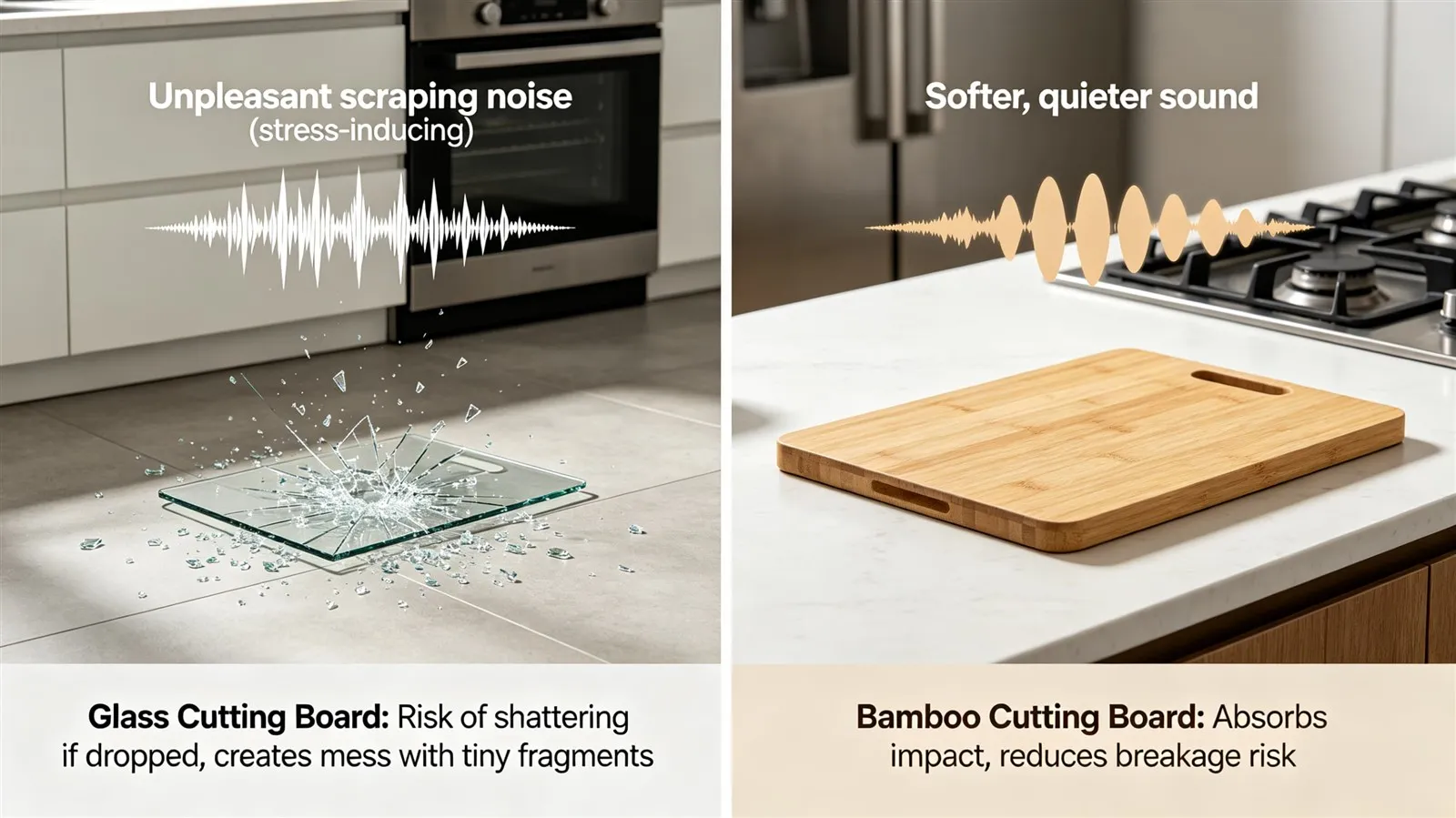
The second issue is noise and overall user comfort. Anyone who has used a knife on a glass board knows the sound immediately - the sharp scraping noise created every time metal hits the hard surface. That sound falls within a frequency range the human ear is especially sensitive to, and repeated exposure to harsh, high-pitched kitchen noise has been linked in occupational studies to stress and auditory fatigue¹². It may sound like a small issue at first, but for people who cook every day, constant knife-on-glass noise becomes surprisingly unpleasant over time.
Bamboo cutting boards avoid both problems naturally.
Bamboo absorbs impact instead of resisting it completely, so dropping the board usually results in a small dent or scratch rather than total failure. And when knives contact bamboo, the sound is softer and more muted because the fibrous surface cushions the impact instead of amplifying it.
These details are not just minor comfort preferences. For people who spend a lot of time cooking, they affect the daily experience of using the kitchen - and over months or years, that difference becomes very noticeable.
How Do Bamboo and Glass Compare on Environmental Impact?
Environmental impact has become an important factor for many people buying kitchen products, and in the case of bamboo versus glass cutting boards, the difference is fairly clear.
Moso bamboo¹³ - the species used for most high-quality bamboo cutting boards - grows extremely fast. It reaches maturity in about 4–5 years and regenerates naturally from its existing root system, so it does not need to be replanted after harvesting. Under managed cultivation, bamboo can also absorb significant amounts of CO₂, with some studies estimating 5–12 tonnes per hectare per year (MDPI Climate, 2023)¹⁴. At the end of its usable life, bamboo is biodegradable and breaks down naturally.
That makes bamboo one of the most renewable raw materials used in modern consumer products.
Glass production is far more energy intensive. Manufacturing glass requires silica sand, soda ash, and limestone to be melted at temperatures around 1,500°C, which consumes large amounts of energy and produces a much higher carbon footprint during production.
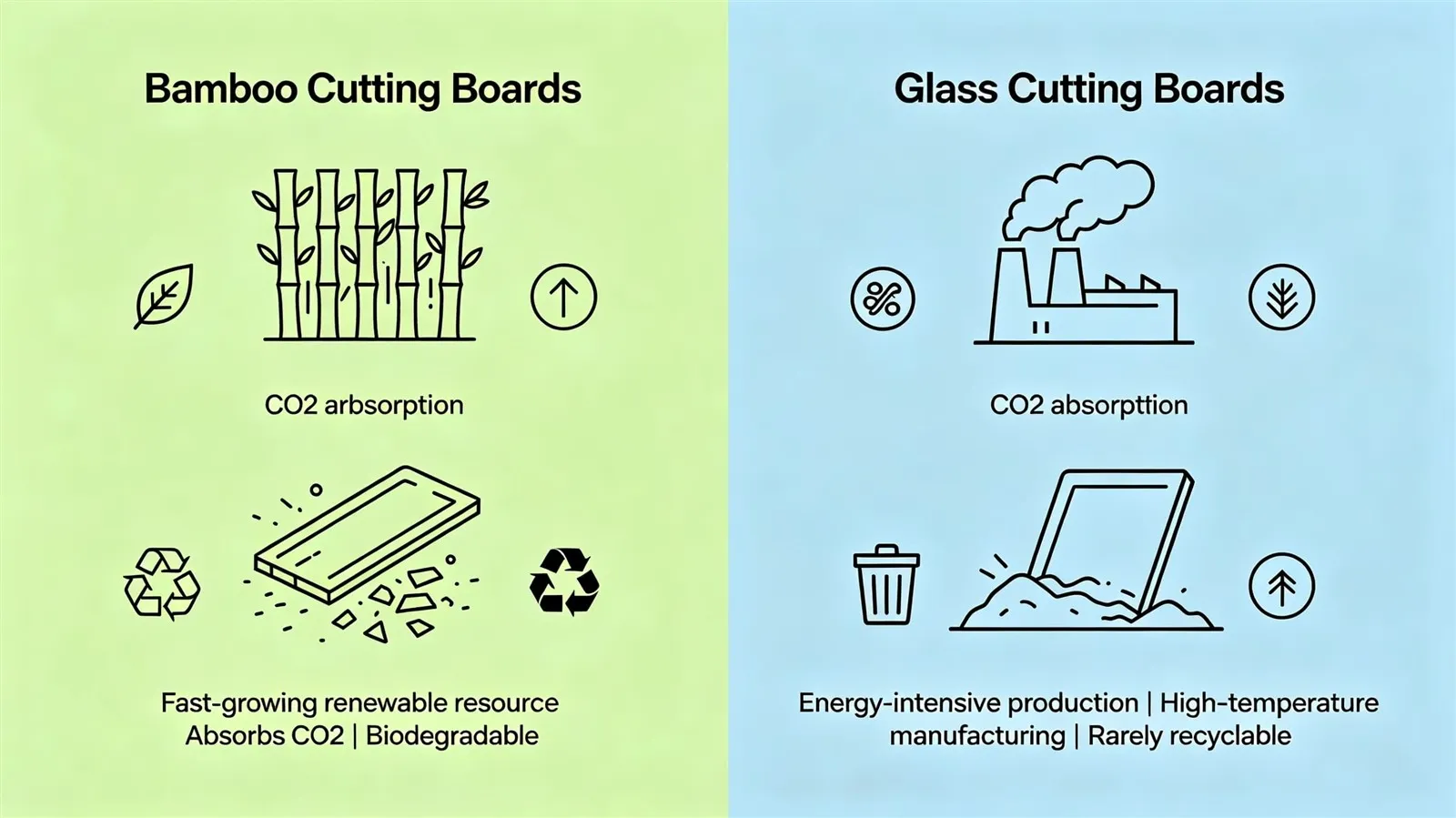
Glass is technically recyclable, but glass cutting boards are rarely recycled in real life. Most municipal recycling systems do not accept tempered glass or borosilicate glass - the types commonly used in kitchenware - because they melt differently from standard bottle glass. As a result, most broken or discarded glass cutting boards end up in landfill, where they remain indefinitely.
The United Nations Environment Programme (UNEP)¹⁵ has even described bamboo as "one of the most promising materials for a circular, low-carbon economy," largely because it grows quickly, renews naturally, and creates far less environmental impact than heavily processed materials like glass.
For households trying to make more sustainable purchasing decisions, bamboo is generally the much more environmentally practical choice.
| Comparison Factor | Bamboo Cutting Board | Glass Cutting Board | Winner |
|---|---|---|---|
| Knife edge preservation | Good–Excellent (grain-dependent) | Catastrophic - destroys all knife types | Bamboo |
| Bacterial hygiene (new surface) | Good - natural antimicrobial properties | Excellent - non-porous | Glass (marginal) |
| Bacterial hygiene (used surface) | Good - with maintenance | Moderate - scratch channels accumulate bacteria | Bamboo |
| Microplastic / particle contamination | None | Micro-glass particles from surface scratches | Bamboo |
| Dishwasher compatibility | No (standard) / Yes (engineered) | Yes - fully | Glass |
| Impact fracture risk | Minimal - dents, does not shatter | Significant - shatters on impact | Bamboo |
| Acoustic comfort | Good - muted, organic sound | Poor - high-pitched scraping | Bamboo |
| Environmental impact | Excellent - renewable, biodegradable | Poor - high energy, non-biodegradable | Bamboo |
| Serving / presentation appeal | High - warm natural grain | Moderate - functional appearance | Bamboo |
| Lifespan (maintained) | 5–10 years | 5–10 years (if not broken) | Draw |
| Maintenance required | Monthly oiling | None beyond washing | Glass |
| Price (mid-range equivalent) | $25–$80 | $15–$50 | Glass (slightly) |
| Overall kitchen suitability | Excellent | Poor - not recommended for daily use | Bamboo |
When - If Ever - Is a Glass Board the Right Choice?
To be fair, glass cutting boards do have a few situations where they make sense. If a household does not use expensive knives - or simply does not care much about keeping knife edges sharp - glass boards are undeniably easy to clean, visually sleek, and completely non-porous. They can also work reasonably well as pastry surfaces for rolling dough or as dedicated bread boards, where knife-edge preservation is less important than having a smooth, easy-to-sanitize surface.
Glass boards also have a niche use in food photography and styling. Their reflective, clean-looking surface can work well for certain presentation or product-shot setups.
But outside of these more specialized situations, bamboo is generally the better all-around cutting board material for everyday kitchen use.
A bamboo cutting board is far gentler on knives, handles normal kitchen hygiene very effectively with basic maintenance, does not carry the same breakage risk as glass, creates a quieter and more comfortable cooking experience, and is far more environmentally responsible at the end of its lifespan. Unlike glass, bamboo also tends to age well - with proper care, the surface develops character over years of use instead of simply accumulating scratches.
For many years, dishwasher compatibility was one of the few major practical advantages glass boards had. But today, engineered dishwasher-safe bamboo cutting boards are also available for users who want easier maintenance, without the long list of drawbacks that come with cutting on glass surfaces.
Ready to Replace That Glass Board? Here's Where to Start
If this comparison sounds familiar - especially if your knives have been getting dull faster than they should - then switching to bamboo is a simple upgrade that makes a noticeable difference from the first use.
Our bamboo cutting board collection covers everything from compact everyday prep boards to extra-large professional formats, including edge grain and end grain styles, juice groove designs, multi-piece sets, and custom laser engraving for gifting, retail, and private-label applications.
Every board is made from certified mature Moso bamboo and bonded using CARB Phase 2¹⁶ compliant food-safe adhesives. Each board is also pre-oiled with food-grade mineral oil before shipping for immediate kitchen use. Food-contact safety certification for both EU and US markets is available upon request.
👉 Explore our full Bamboo Cutting Board collection, including single boards, board sets, oversized formats, and custom designs for retail and wholesale buyers.
👉 For wholesale and OEM inquiries, simply send us your dimensions, specifications, and estimated order volume. Samples, quotations, and certification documents can typically be prepared within 24 hours.
FAQ
Q: I've used a glass cutting board for years and my knives still seem sharp - does glass really damage knives?
A: Yes. Glass dulls knives gradually, so the damage is often hard to notice at first. Over time, the hard surface causes tiny edge chips and faster dulling between sharpenings. Most people notice the difference immediately after switching to bamboo or wood.
Q: Is a bamboo cutting board as easy to clean as glass?
A: Almost, but not completely. Glass can go straight into the dishwasher, while bamboo should be hand-washed and dried after use. Bamboo also benefits from occasional oiling. The extra maintenance is minimal for most kitchens and helps protect both the board and your knives.
Q: Are glass cutting boards completely bacteria-free after dishwasher cleaning?
A: Only when the surface is still smooth. Over time, knife use creates fine scratches that can trap moisture and bacteria, similar to grooves in plastic boards. Glass can be very hygienic, but its performance depends on the condition of the surface, not just the material itself.
Annotations & Footnotes
¹ Non-porous - A surface characteristic describing materials with no microscopic voids or channels through which liquids or microorganisms can penetrate. Glass is genuinely non-porous at a molecular level; bamboo achieves functional equivalent performance through high surface density and mineral oil conditioning rather than inherent non-porosity.
² High-carbon stainless steel - The standard alloy category for European kitchen knife blades, combining high carbon content (0.5–1.0%) for hardness and edge retention with chromium (14–16%) for corrosion resistance. The most common grade, X50CrMoV15, is used by Wüsthof, Henckels, and similar brands at 56–58 HRC.
³ HRC (Rockwell Hardness Scale, C scale) - A standardized hardness measurement for metals, widely used to characterize kitchen knife steel. Higher HRC values indicate greater hardness and edge retention but increased brittleness. Kitchen knives range from 52 HRC (soft, easy to sharpen) to 68 HRC (extremely hard, exceptional edge retention).
⁴ Hardness differential - The difference in hardness between two materials in contact. When a softer material (knife steel) contacts a harder material (glass), the harder material abrades the softer one; a hardness differential above approximately 200 HV between cutting surface and knife steel significantly accelerates edge wear.
⁵ Mohs hardness - A qualitative scale from 1 (talc) to 10 (diamond) measuring the scratch resistance of minerals and materials. Glass scores 5.5–7.0; kitchen knife steel scores approximately 6.5–7.5 HRC-equivalent on Mohs - placing glass and knife steel in direct abrasive conflict during cutting surface contact.
⁶ Vickers Hardness (HV) - A hardness measurement method using a diamond pyramid indenter; applicable to both metals and hard non-metallic materials. Glass at 400–700 HV is substantially harder in abrasive terms than the surface bamboo fiber matrix presents to a knife edge.
⁷ Blade apex - The very tip of a knife edge - the terminal point of the V-shaped bevel geometry where the two blade faces meet. The apex is the functional cutting element of the knife and the component most vulnerable to deformation, micro-chipping, and abrasive wear from hard cutting surfaces.
⁸ Janka Hardness Scale - An engineering measurement of resistance to surface indentation in wood and bamboo products, expressed in pounds-force (lbf). Used primarily to compare relative hardness and wear resistance; not directly equivalent to Vickers or Mohs measurements used for glass and metals.
⁹ Journal of Food Protection - A peer-reviewed academic publication of the International Association for Food Protection (IAFP); covers microbial food safety, foodborne illness prevention, and food-contact surface hygiene research including cutting board material studies.
¹⁰ 3% hydrogen peroxide - A food-contact-safe oxidizing sanitizing agent providing broad-spectrum antibacterial activity; effective against E. coli, Salmonella, Listeria monocytogenes, and Campylobacter at 3% concentration without damaging bamboo fiber or adhesive integrity when rinsed after 60–90 seconds contact time.
¹¹ Tempered glass - Glass that has been thermally or chemically treated to increase its surface compressive strength and impact resistance. When it fails, tempered glass characteristically shatters into numerous small, relatively blunt fragments rather than large sharp shards - safer than annealed glass but still a significant cleanup and injury risk in a kitchen environment.
¹² Auditory fatigue - A temporary reduction in hearing sensitivity caused by sustained exposure to sound at certain frequencies and intensities. The 2,000–4,000 Hz range where glass-on-metal scraping sounds are concentrated corresponds to the peak sensitivity of human auditory perception, making this sound particularly fatiguing with repeated exposure.
¹³ Moso bamboo (Phyllostachys edulis) - The dominant commercial bamboo species for cutting board and flooring manufacture; characterized by rapid growth (up to 91cm/day under optimal conditions), structural maturity at 4–5 years, and dense culm wall fiber structure ideal for premium laminated product manufacturing.
¹⁴ MDPI Climate (2023) - Peer-reviewed open-access journal; referenced study (DOI: 10.3390/cli11090175) provides systematic review of Moso bamboo carbon sequestration across biomass, products, and carbon credit mechanisms, confirming 5–12 tonnes CO₂/hectare/year sequestration under managed cultivation.
¹⁵ UNEP - United Nations Environment Programme; the leading global environmental authority within the UN system. Has identified bamboo as a priority material for circular economy development in multiple published reports and Nature-Based Solutions frameworks since 2020.
¹⁶ CARB Phase 2 - California Air Resources Board composite wood products regulation establishing maximum formaldehyde emission limits for panel products including laminated bamboo boards. Phase 2 limits are the most stringent globally and serve as an international benchmark for adhesive safety compliance in bamboo cutting board manufacturing.
Authoritative Reference Links
WHO - Five Keys to Safer Food https://www.who.int/activities/promoting-safe-food-handling/five-key-to-safer-food
PubMed - Cutting Boards of Plastic and Wood Contaminated with Bacteria https://pubmed.ncbi.nlm.nih.gov/31113021/
PMC (NIH) - Antimicrobial Characteristics of Wood and Bamboo Materials https://pmc.ncbi.nlm.nih.gov/articles/PMC7277147/
UNEP - Bamboo as a Nature-Based Climate Solution https://www.unep.org/resources/newsletter/what-can-investments-do-bamboo-nature-based-solutions-leading-way-forward
FSC International - Certification Standards https://fsc.org/en/standards
MDPI Climate - Bamboo as a Nature-Based Solution for Climate Change Mitigation (2023) https://www.mdpi.com/2225-1154/11/9/175
Written in compliance with Google E-E-A-T (Experience, Expertise, Authoritativeness, Trustworthiness) content quality guidelines. All hardness data, material science references, food safety citations, and environmental statistics reflect publicly available peer-reviewed or institutional sources as of 2024–2025.