






High-quality bamboo kitchen utensils are not determined by appearance alone. The real differences come from bamboo material grade, manufacturing processes, surface treatment, and verified food-contact safety standards.
Two bamboo spatulas may look almost identical, yet their performance and safety can vary significantly depending on the quality of the raw bamboo, adhesive system, and finishing process used. Poorly processed products may have issues such as rough surfaces, excessive moisture absorption, cracking, or inadequate chemical safety control.
This guide explains the key factors that distinguish premium bamboo kitchen utensils from lower-quality alternatives, including the materials to look for, certifications to verify, and practical quality checks for both consumers and wholesale buyers.
What Makes Bamboo Kitchen Utensils "High-Quality"?
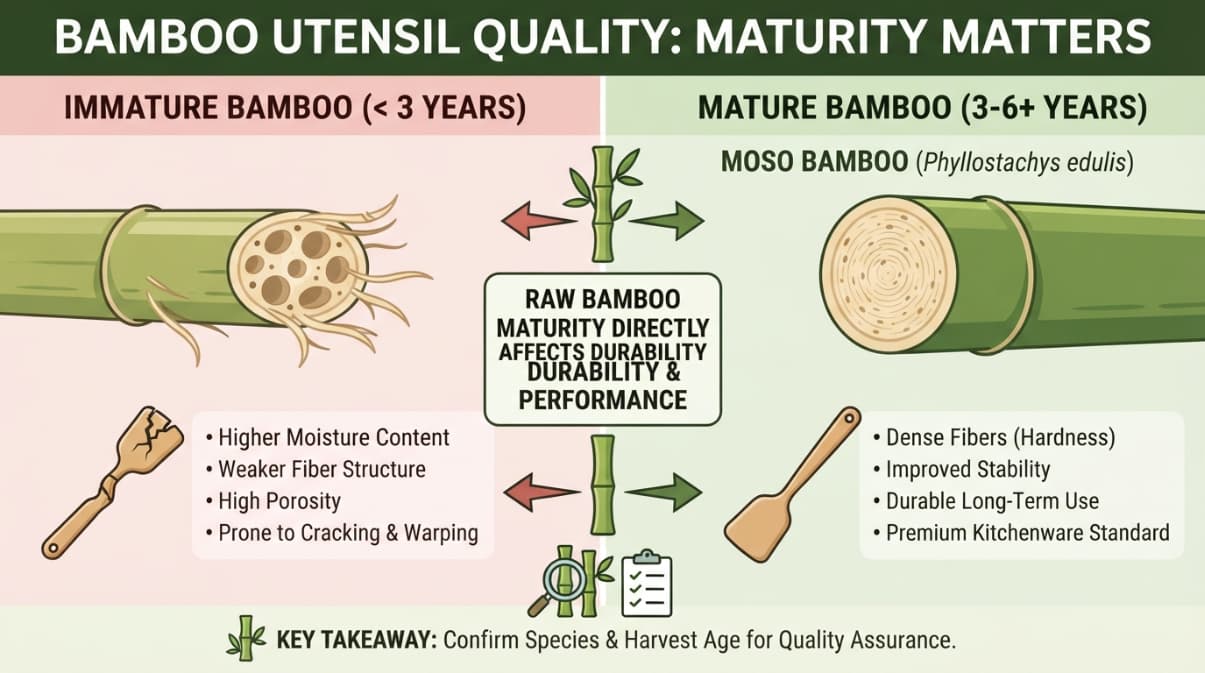
The quality of bamboo kitchen utensils depends largely on three factors: raw bamboo maturity, adhesive and finish selection, and manufacturing consistency. The bamboo used at the beginning of production directly affects the product's durability, appearance, and long-term performance.
Immature bamboo has a higher moisture content, weaker fiber structure, and greater porosity, making it more likely to crack, warp, or deteriorate during daily kitchen use. In contrast, mature bamboo harvested after approximately 3–6 years of growth develops denser fibers and improved stability, making it better suited for durable kitchen utensils.
Is All Bamboo the Same?
No. Different bamboo species have different structural properties. Moso bamboo (Phyllostachys edulis) is widely used in premium bamboo kitchenware because of its dense fiber structure, hardness, and good dimensional stability.
However, some suppliers may use faster-growing bamboo varieties with lower density to reduce costs. For wholesale buyers, it is important to confirm the bamboo species, harvest age, and sourcing standards before placing an order, as these factors directly influence product quality and lifespan.
Why Does Bamboo Quality Vary So Much Between Suppliers?
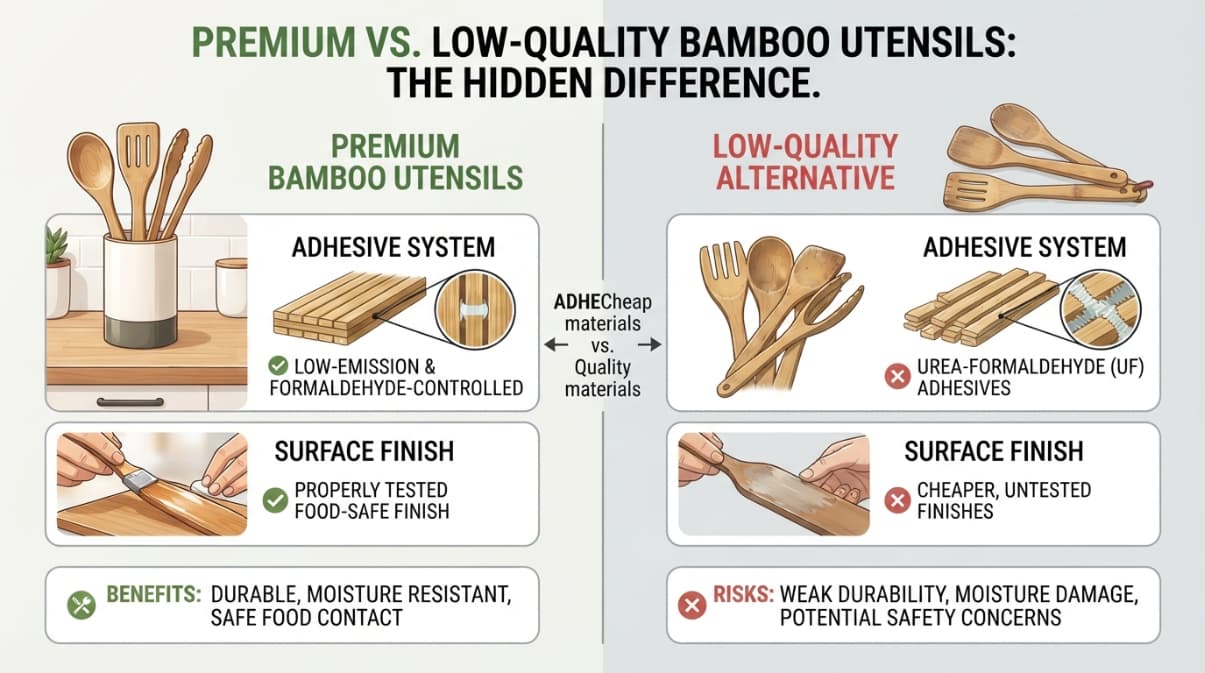
The difference between a premium bamboo kitchen utensil set and a low-quality alternative often comes down to two factors that are not immediately visible: the adhesive system used during production and the safety of the surface finish.
Because many bamboo utensils are made by laminating multiple bamboo strips, the quality of the adhesive directly affects long-term durability, moisture resistance, and product safety. Lower-cost manufacturers may use urea-formaldehyde (UF) adhesives because of their lower cost, but these systems generally offer weaker moisture resistance compared with higher-grade alternatives.
Reputable manufacturers producing high-quality bamboo kitchen utensils typically choose low-emission or formaldehyde-controlled adhesive systems and apply properly tested food-safe finishes. Although these materials increase production costs, they provide better performance, improved safety, and greater confidence for both retailers and end users.
What Certifications Should High-Quality Bamboo Kitchen Utensils Have?
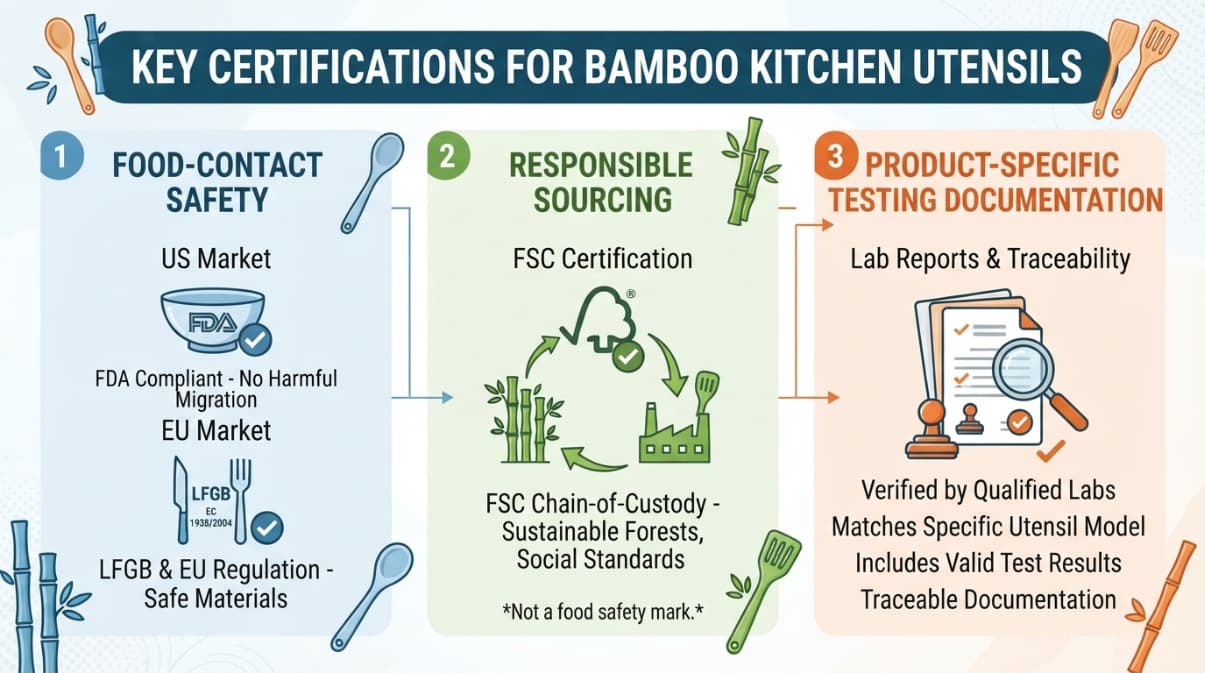
Certifications help distinguish genuine quality control from simple marketing claims. For bamboo kitchen utensils sold in North America and Europe, three areas are especially important: food-contact safety, responsible sourcing, and product-specific testing documentation.
For the US market, FDA food-contact compliance requires materials to meet applicable safety requirements and pass testing to ensure that no harmful substances migrate into food during normal use. In Europe, buyers often look for LFGB compliance and conformity with EU Regulation (EC) No 1935/2004, which sets requirements for materials intended to come into contact with food.
What Is FSC Certification and Why Does It Matter?
FSC (Forest Stewardship Council) certification focuses on responsible material sourcing rather than food safety. Through its chain-of-custody system, FSC tracks materials from responsibly managed forests or bamboo sources through processing and manufacturing.
While FSC certification does not prove that a utensil is food-safe, it provides assurance that the bamboo supply chain follows recognized environmental and social standards. This is increasingly important for retailers and brands developing sustainable kitchenware collections.
What Do FDA and LFGB Documents Actually Prove?
Food-contact compliance is product-specific, not a general claim that applies to every item a supplier produces. Buyers should verify that test reports:
Match the exact bamboo utensil model being purchased
Are issued by qualified third-party laboratories
Include relevant food-contact testing results
Remain valid and traceable
Requesting current documentation before production helps reduce compliance risks and ensures the finished product meets the requirements of the target market.
| Certification | Region | What It Verifies |
|---|---|---|
| FDA 21 CFR Part 177 | United States | No harmful substance migration from food-contact surface |
| LFGB / EU 1935/2004 | Europe | Strict chemical migration and material safety limits |
| FSC Chain of Custody | Global | Bamboo sourced from responsibly managed forests |
| BPA-Free Declaration | Global | No bisphenol-A in coatings or adhesives |
How Can You Tell If a Bamboo Kitchen Utensil Set Is Well-Made?
Certifications are important, but physical inspection can quickly reveal manufacturing quality. Before purchasing bamboo kitchen utensils, buyers should pay attention to surface finishing, bonding quality, and overall workmanship.
Run your hand along the edges, handles, and joints. High-quality bamboo utensils should have:
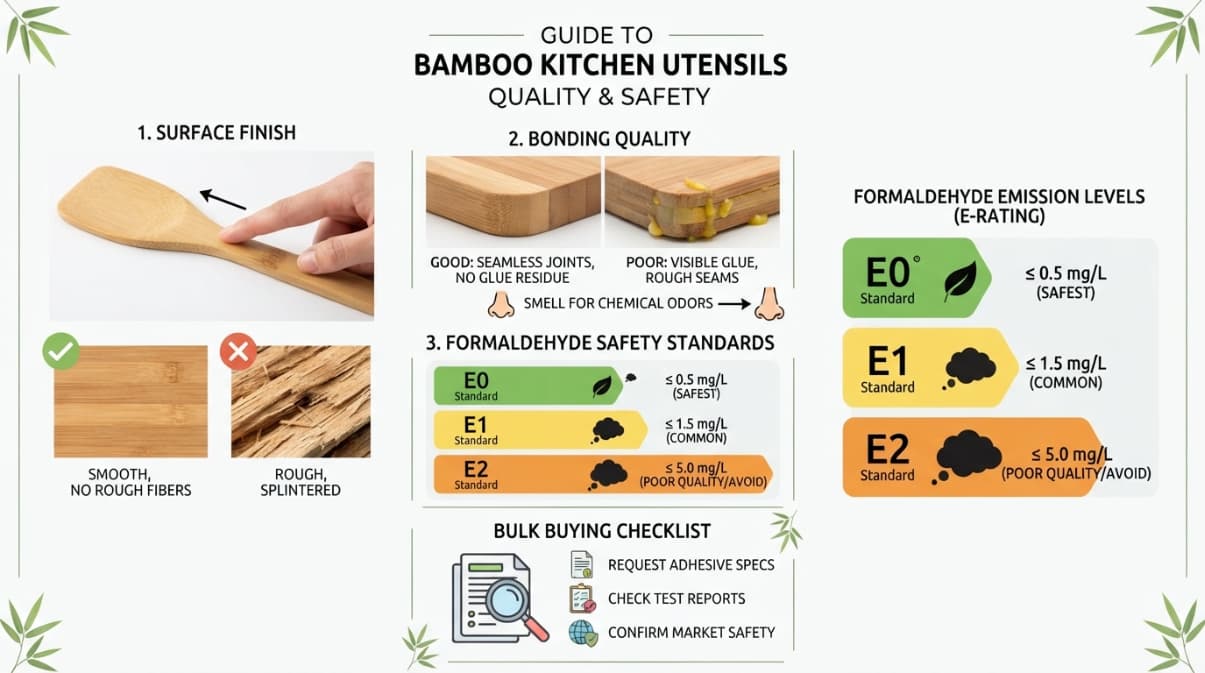
Smooth surfaces without rough sanding marks or raised fibers
Clean, seamless joints without visible glue residue
A natural feel without an excessive synthetic shine that may indicate a heavy coating rather than a suitable food-safe finish
Odor is another useful quality indicator. A strong chemical smell or sharp odor immediately after opening the package may suggest excessive adhesive residue, poor curing, or the use of lower-grade bonding materials.
What Formaldehyde Levels Are Safe in Bamboo Products?
For laminated bamboo products, formaldehyde emission standards help measure adhesive safety. Common emission classifications include:
E0: ≤0.5 mg/L formaldehyde emission
E1: ≤1.5 mg/L formaldehyde emission
E2: ≤5.0 mg/L formaldehyde emission
Lower emission levels indicate stricter control of formaldehyde release. For food-related bamboo products, reputable manufacturers typically use low-emission adhesive systems and maintain proper curing and testing procedures.
When sourcing bamboo kitchen utensils in bulk, buyers should request adhesive specifications and relevant test reports to confirm that the product meets the safety requirements of the target market.
| Emission Grade | Formaldehyde Limit | Recommended For |
|---|---|---|
| E0 | ≤ 0.5 mg/L | High-quality bamboo kitchen utensils, children's tableware |
| E1 | ≤ 1.5 mg/L | Standard acceptable grade for most markets |
| E2 | ≤ 5.0 mg/L | Avoid for food-contact or kitchen use |
What Red Flags Signal Low-Quality Bamboo Kitchen Accessories?
Several common indicators can help buyers identify lower-quality bamboo kitchen accessories before placing an order. These warning signs often reveal shortcuts in material selection, manufacturing processes, or quality control.
No bamboo species or harvest-age information - Claims such as "100% natural bamboo" provide little insight into actual quality. Reliable suppliers should be able to specify the bamboo species, maturity, and sourcing details.
Missing or unverifiable test reports - Genuine certifications should be traceable to recognized testing laboratories. Documents that cannot be verified or do not match the exact product should be treated with caution.
Uneven appearance or visible bonding lines - Inconsistent color, rough joints, or excessive seams may indicate poor material selection, mixed bamboo grades, or weak processing control.
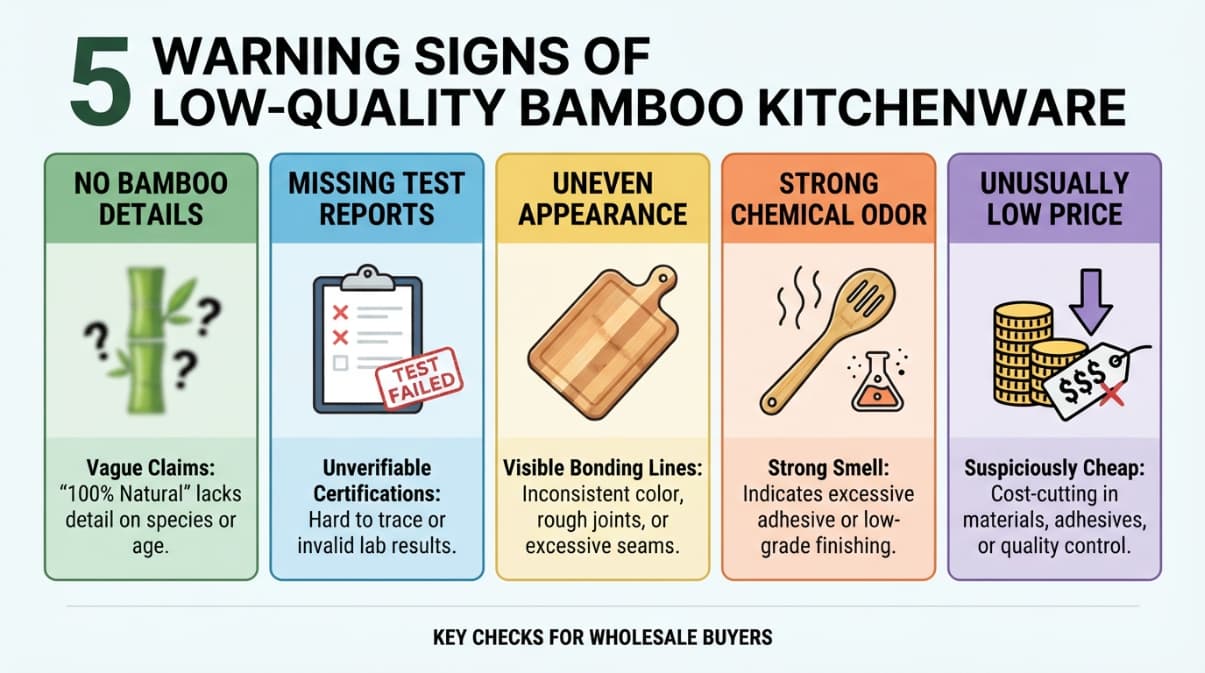
Strong chemical odor - A noticeable smell after unpacking may indicate excessive adhesive residue, poor curing, or the use of lower-grade finishing materials.
Unusually low pricing - Extremely low bulk prices often mean cost reductions somewhere in the supply chain, such as cheaper bamboo materials, lower-grade adhesives, limited testing, or reduced quality inspection.
For wholesale buyers, evaluating these details before production helps avoid inconsistent quality, compliance issues, and unnecessary replacement costs. A reliable bamboo kitchen accessory supplier should provide transparent material information, testing documentation, and consistent manufacturing standards.
How Should You Test Bamboo Kitchen Utensils Before Buying in Bulk?
For wholesale buyers, a short pre-order verification process prevents costly returns and compliance issues down the line.
| Step | What to Do | What It Confirms |
|---|---|---|
| 1. Request documentation | Ask for current FDA/LFGB test reports tied to the exact SKU | Legal compliance for your target market |
| 2. Inspect a physical sample | Check grain, joints, finish, and smell | Manufacturing quality |
| 3. Soak test | Submerge a sample in warm water for 30 minutes | Resistance to warping and delamination |
| 4. Check supplier traceability | Confirm FSC chain-of-custody documentation | Sustainable and legal bamboo sourcing |
| 5. Order a small trial batch | Test real-world durability before committing to full volume | Consistency across a full production run |
How Do Organic Bamboo Cooking Utensils Differ From Standard Ones?
Organic Bamboo vs. Standard Certified Bamboo
Organic bamboo kitchen utensils are made from bamboo grown without synthetic pesticides or chemical fertilizers. This distinction mainly relates to the raw material sourcing process and is most relevant for buyers seeking additional sustainability credentials.
However, organic sourcing does not automatically determine food safety. Whether bamboo is organic or conventionally sourced, the finished product still requires proper processing, safe adhesives, suitable finishes, and verified food-contact compliance.
For most retailers and wholesale buyers, high-quality bamboo kitchen utensils with FDA, LFGB, and FSC documentation already provide strong assurance of safety, quality, and responsible sourcing. Organic certification can serve as an additional sustainability feature rather than a replacement for product testing and manufacturing controls.

Final Thoughts
Selecting high-quality bamboo kitchen utensils should be based on verifiable standards rather than appearance or marketing claims. Mature bamboo materials, low-emission adhesive systems, food-safe finishes, and reliable third-party certifications are the key indicators of a trustworthy product.
A well-manufactured bamboo kitchen utensil set reflects quality at every stage - from raw bamboo selection to final inspection and compliance documentation.
If you are looking to source certified bamboo kitchen utensils, bamboo cooking tools, or custom bamboo kitchen accessories for retail or wholesale, explore our product catalog or contact our team to discuss OEM/ODM requirements, certifications, and bulk production options.
FAQ
Q: How do I know if bamboo utensils are food-safe?
A: Ask for current FDA or LFGB test reports tied to the specific product, not just the raw bamboo material.
Q: Is more expensive bamboo always better quality?
A: Usually yes - proper adhesives, testing, and mature bamboo all add cost, so extremely cheap pricing is a red flag.
Q: Can I test bamboo utensil quality myself at home?
A: Yes - check for smooth joints, no chemical smell, and try a warm-water soak test to check for warping.
Notes and Definitions
Moso bamboo (Phyllostachys edulis) - the bamboo species most commonly used in kitchenware due to its thick, dense culm walls.
Chain of custody - a certification system tracking a material from its certified source through every stage of manufacturing.
Formaldehyde emission grade (E0/E1/E2) - a classification system measuring how much formaldehyde gas a bonded wood or bamboo product releases.
Migration testing - laboratory testing that measures whether chemicals transfer from a material into food under normal use.
LFGB - Germany's food and feed code, widely regarded as one of the strictest food-contact material standards in the world.
References
Are Bamboo Utensils Safe? FDA, Chemical & Food Safety Guide - Friendly Bamboo
Food-Contact Compliance for Bamboo: FDA vs LFGB vs EU - Bamboozio
Determining the Regulatory Status of Components of a Food Contact Material - FDA.gov
What is FSC? - Forest Stewardship Council
Plywood Formaldehyde Emission Standards: E0, E1, and E2 Classification - Sumec Building Material