



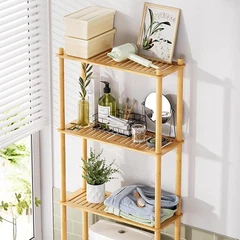
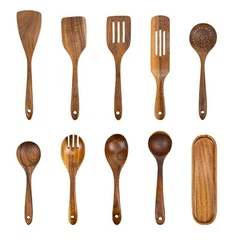
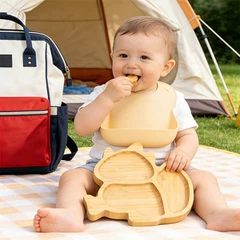


Bamboo is not a uniform material - species, maturity, and processing quality all influence how a kitchen utensil performs over time. Among commercially used bamboo species, Moso bamboo (Phyllostachys edulis) is widely used for kitchenware because it offers a strong balance of density, hardness, durability, and workability.
This guide explores why Moso is so well suited to bamboo kitchen utensils, how it compares with alternatives such as Guadua, and how harvest age, moisture control, and processing methods influence the quality and service life of the finished utensil.
Why Species Selection Matters More Than Most Buyers Realize
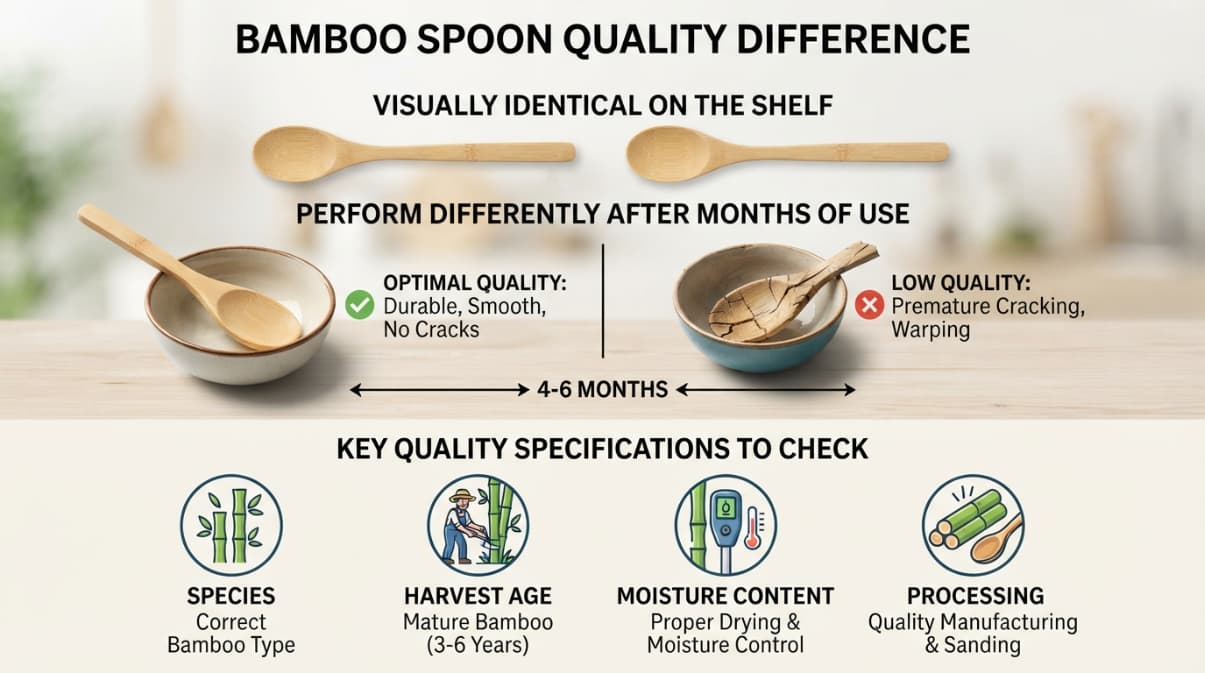
Two bamboo spoons can look almost identical on the shelf yet perform very differently after months of use. The difference often comes down to bamboo species, harvest age, moisture content, and processing quality - details that are rarely shown on retail packaging but should be easy for a reputable supplier to explain.
Getting these specifications right from the start can help reduce two of the most common quality problems in bamboo kitchenware: premature cracking and surface warping. For wholesale buyers, asking for clear material and moisture specifications before placing an order is a simple way to improve product consistency and reduce quality risks.
Which Bamboo Species Dominates Commercial Kitchenware?
Moso bamboo (Phyllostachys edulis) is one of the most commercially important bamboo species for kitchenware, particularly in China. Its widespread use is not simply a matter of availability - its combination of density, hardness, workability, and consistent processing characteristics makes it well suited to everyday utensils.
What Physical Traits Make Moso Suitable for Utensils?
Moso bamboo has a dense fiber structure that provides good resistance to scratching, denting, and everyday wear, while remaining workable enough to produce smooth, precisely shaped spoons, spatulas, tongs, and other utensils.

Its relatively high silica content also contributes to bamboo's hardness and wear resistance. However, finished-product performance depends on more than silica alone - bamboo maturity, moisture content, processing method, construction, and surface finishing all influence the final quality.
For manufacturers and wholesale buyers, this combination makes Moso a practical material when the goal is to produce durable, lightweight, and consistently finished bamboo kitchen utensils.
| Trait | Moso Bamboo | Lower-Grade / Unspecified Species |
|---|---|---|
| Silica content | Higher, contributes to hardness | Often lower, softer finished product |
| Fiber density | Consistent, tight grain | Variable, prone to porosity |
| Workability | Smooth shaping, minimal splintering | Rougher finish, more waste in production |
| Industry adoption | Dominant in kitchenware manufacturing | Used mainly in low-cost, unbranded goods |
How Does Moso Compare to Guadua Bamboo for Kitchen Use?
Guadua (Guadua angustifolia) is another commercially important bamboo species, particularly in South America, and it provides a useful comparison when evaluating bamboo for different applications.
Is Guadua Stronger Than Moso Bamboo?
Guadua can offer excellent structural strength, making it well suited to construction and other load-bearing applications. However, greater structural strength does not automatically make it a better material for kitchen utensils.

Guadua generally has thicker culm walls than Moso, which can make it less convenient to process into the thin, precise shapes required for spoons, spatulas, and other utensils. Moso bamboo offers a more practical balance of hardness, workability, availability, and processing consistency, which helps explain its widespread use in bamboo kitchenware.
For kitchen utensils, the goal is not simply maximum strength - it is the right combination of hardness, workability, dimensional stability, and finish quality.
| Comparison Point | Moso Bamboo | Guadua Bamboo |
|---|---|---|
| Tensile strength | 150–280 N/mm² | Exceeds mild steel |
| Wall thickness | 6–10 mm (thinner, more workable) | ~13 mm (thicker, structural) |
| Best suited for | Kitchen utensils, cutting boards, flooring | Construction, load-bearing structures |
| Global kitchenware market share | Dominant | Minimal outside South America |
Does Harvest Age Change Utensil Quality?
Species alone does not determine bamboo quality - harvest age is equally important. Bamboo harvested too young generally has higher moisture content and less-developed fiber structure, which can increase the risk of cracking, warping, and dimensional instability during everyday use.
At What Age Is Bamboo Mature Enough for Utensils?
For many kitchenware applications, reputable manufacturers typically use bamboo harvested at around 3–6 years of age, when the fibers have developed greater density and structural stability.
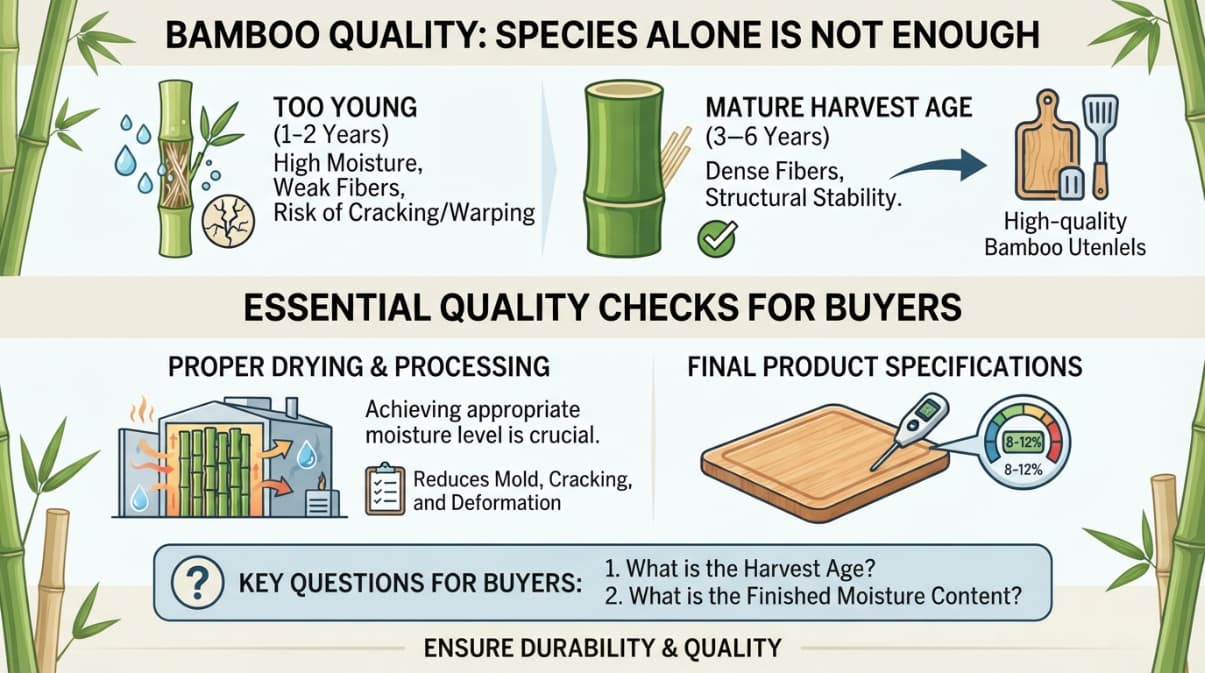
After proper drying and processing, finished bamboo products are commonly brought to an appropriate moisture level before production and shipment. The target depends on the product, construction, and destination climate, but controlling moisture is essential for reducing the risk of mold, cracking, and deformation.
For buyers, asking both "What is the harvest age?" and "What is the finished moisture content?" provides a much better indication of raw-material quality than species claims alone.
What Processing Steps Affect Bamboo's Final Hardness?
Species and harvest age are only part of the equation. Processing method has a major impact on the hardness, durability, and workability of the finished bamboo utensil.
Strand-woven bamboo is produced by compressing bamboo fibers under high heat and pressure, creating an exceptionally dense material. It is significantly harder than conventional bamboo and many common hardwoods, making it suitable for demanding applications where maximum hardness is required.
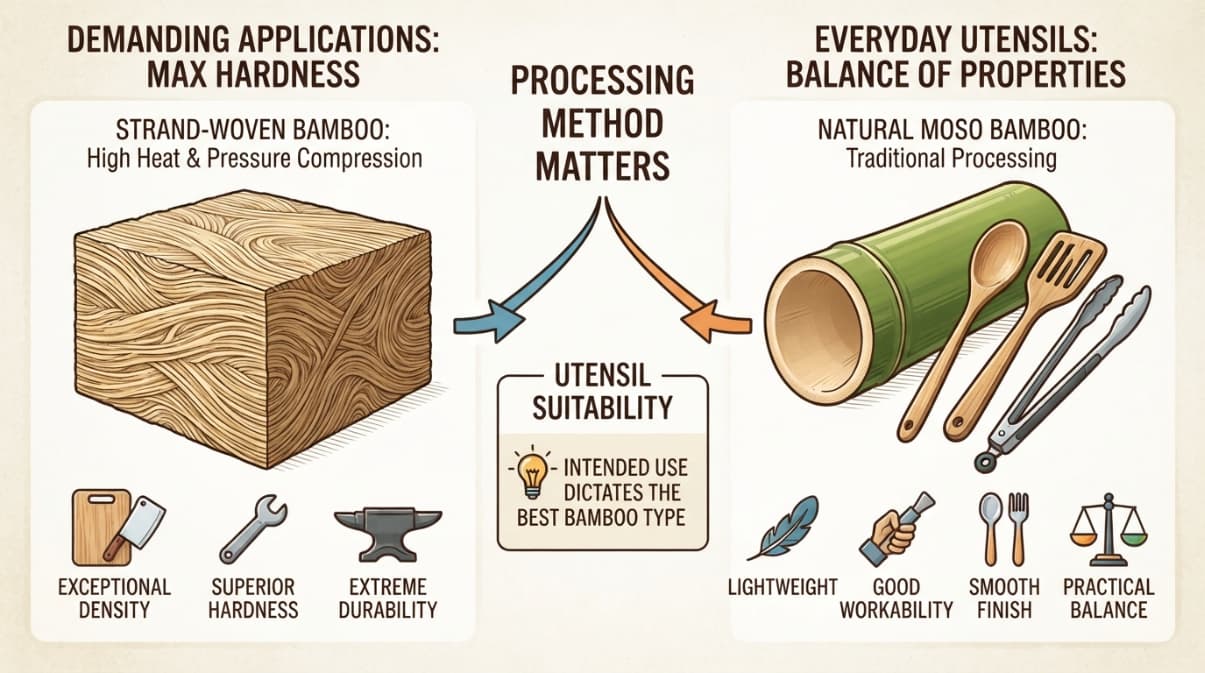
For everyday kitchen utensils, however, natural, non-strand-woven Moso bamboo remains a practical choice. It provides a good balance of hardness, lightweight performance, workability, and smooth finishing, making it well suited to spoons, spatulas, tongs, and other cooking tools.
In other words, the hardest bamboo is not necessarily the best bamboo for every utensil. The ideal processing method depends on the product's intended use, required strength, shape, and manufacturing requirements.
What Should You Ask a Supplier Before Ordering Bamboo Utensils?
A few direct questions can quickly reveal whether a supplier is using genuine, well-sourced Moso bamboo or a lower-cost substitute:
1. What species of bamboo do you use? Can you provide documentation confirming it is Moso bamboo (Phyllostachys edulis)?
2. What is the harvest age? Mature bamboo should be sourced within an appropriate age range for the intended product.
3. Is the bamboo FSC-certified? If so, can you provide the relevant certificate and chain-of-custody documentation?
4. What is the finished product's moisture content? Ask for recent moisture-testing records rather than relying on a general specification.
5. Do you have material testing reports? Request available documentation for density, hardness, and other relevant physical properties.

For wholesale buyers, the important point is to ask for batch-specific or product-specific documentation whenever possible. A supplier that can clearly explain its raw-material sourcing and provide supporting records gives you much more confidence than one relying only on "100% natural bamboo" claims.
Choosing the Right Bamboo Starts With Asking the Right Question
The best bamboo for kitchen utensils is not simply a marketing label - it comes down to a verifiable combination of species, harvest age, and processing quality. Moso bamboo (Phyllostachys edulis), when harvested at maturity and properly processed, offers the density, strength, and durability needed for everyday cooking utensils.
For buyers sourcing bamboo kitchen utensils, verifying the bamboo species, harvest age, moisture content, and processing standards can provide a clearer picture of product quality than appearance or marketing claims alone.

If you're sourcing bamboo kitchen utensils and need documentation on material specifications, moisture testing, construction, or customization, our team can provide the relevant details and discuss your requirements directly.
Guanglong Bamboo & Wood Co., Ltd.
No. 3, Wuyi 3rd Road, Jian'ou City, Nanping City, Fujian Province, 353100
Phone: +86 158 8924 9154
Email: sales02@szmsl68.com
Further reading
Are Bamboo Utensils Safe For Cooking? What Buyers Should Know
Bamboo Vs Wood Kitchen Utensils: Which Is Better?
How To Choose High-Quality Bamboo Kitchen Utensils: A Buyer's Guide
FAQ
Q: What is the best bamboo species for kitchen utensils?
A: Moso bamboo (Phyllostachys edulis) is widely used for kitchenware because of its good combination of density, hardness, durability, and workability.
Q: Is Guadua bamboo better than Moso for kitchenware?
A: Not necessarily. Guadua can offer excellent structural strength, but Moso is generally more practical for producing precisely shaped kitchen utensils because of its processing characteristics.
Q: Why does bamboo harvest age matter?
A: Harvest age affects fiber maturity, density, moisture content, and dimensional stability. Bamboo harvested too young tends to have less mature fibers and can be more susceptible to cracking or deformation. For many commercial applications, 3–6 years is a common mature harvesting range, depending on the species and intended use.
Notes and Definitions
Moso bamboo (Phyllostachys edulis) - the bamboo species most widely used in commercial kitchenware manufacturing.
Guadua (Guadua angustifolia) - a South American bamboo species valued for exceptional structural tensile strength.
Tensile strength - the maximum pulling force a material can withstand before breaking, measured in N/mm².
Strand-woven bamboo - bamboo fiber compressed under heat and pressure into an especially dense, hard material.
Silica content - a naturally occurring mineral compound in bamboo fiber that contributes to hardness and wear resistance.
References
Guadua Bamboo vs Moso Bamboo: Which is Stronger? - The Best Bamboo
Comparing Mechanical Properties of Bamboo: Guadua vs Moso - Guadua Bamboo
The Difference Between Moso Bamboo and Other Species - Ambient
Are Bamboo Cooking Utensils Safe? - Lilly Teak
Types of Bamboo: Species, Uses & Why They Matter - Ambient