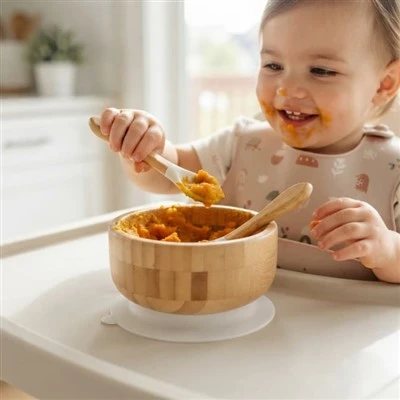





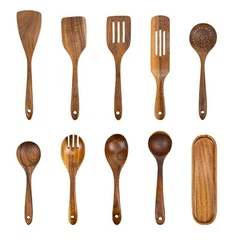
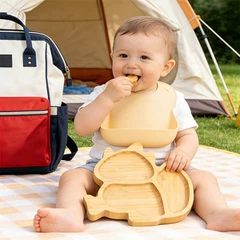


Bamboo utensils are generally safe for cooking when they are properly manufactured and finished for food contact. Solid bamboo itself does not contain BPA, and its natural heat resistance makes it suitable for normal stovetop cooking.
The more important safety question is not the bamboo itself, but the materials used to process and finish it. Adhesives, coatings, stains, and other treatments can affect the safety of a bamboo utensil, particularly when it comes into contact with hot food.
This guide explains when bamboo utensils are safe to use, what potential risks to look for, and which materials and certifications buyers should check before purchasing - whether for everyday kitchen use or wholesale sourcing.
Yes, Solid Bamboo Utensils Are Safe - With One Important Caveat
Solid bamboo utensils are generally safe for normal cooking use when they are properly processed and intended for food contact. The main concern is not the bamboo itself, but the additional materials used in composite or laminated products.
Some lower-cost products are made from bamboo powder or fibers combined with synthetic resins rather than solid bamboo. In these products, the resin and other additives - rather than the bamboo - determine much of the product's food-contact safety.
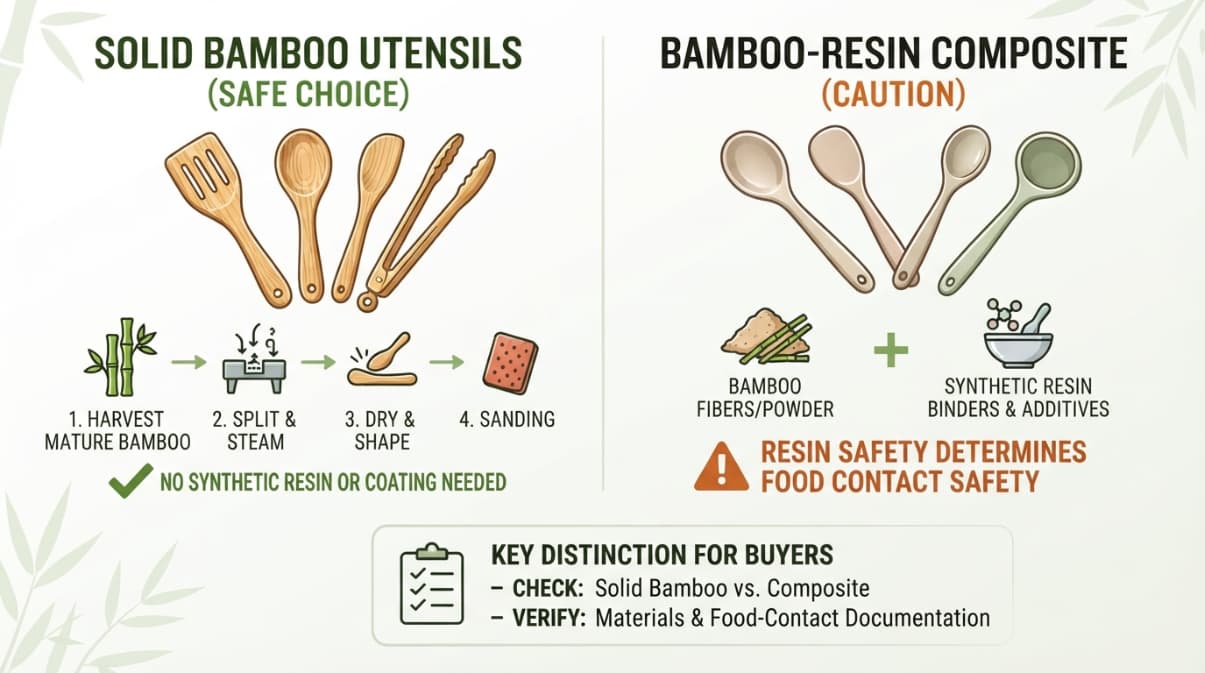
High-quality solid bamboo utensils can be produced through mechanical and thermal processing, including harvesting mature
bamboo, splitting, steaming, drying, shaping, hot pressing where required, and sanding. Depending on the product design, no synthetic resin or surface coating may be necessary.
For buyers, the key distinction is therefore simple: check whether the utensil is made from solid bamboo or a bamboo-resin composite, and verify the materials and food-contact documentation before purchasing.
What Temperature Can Bamboo Utensils Safely Handle?
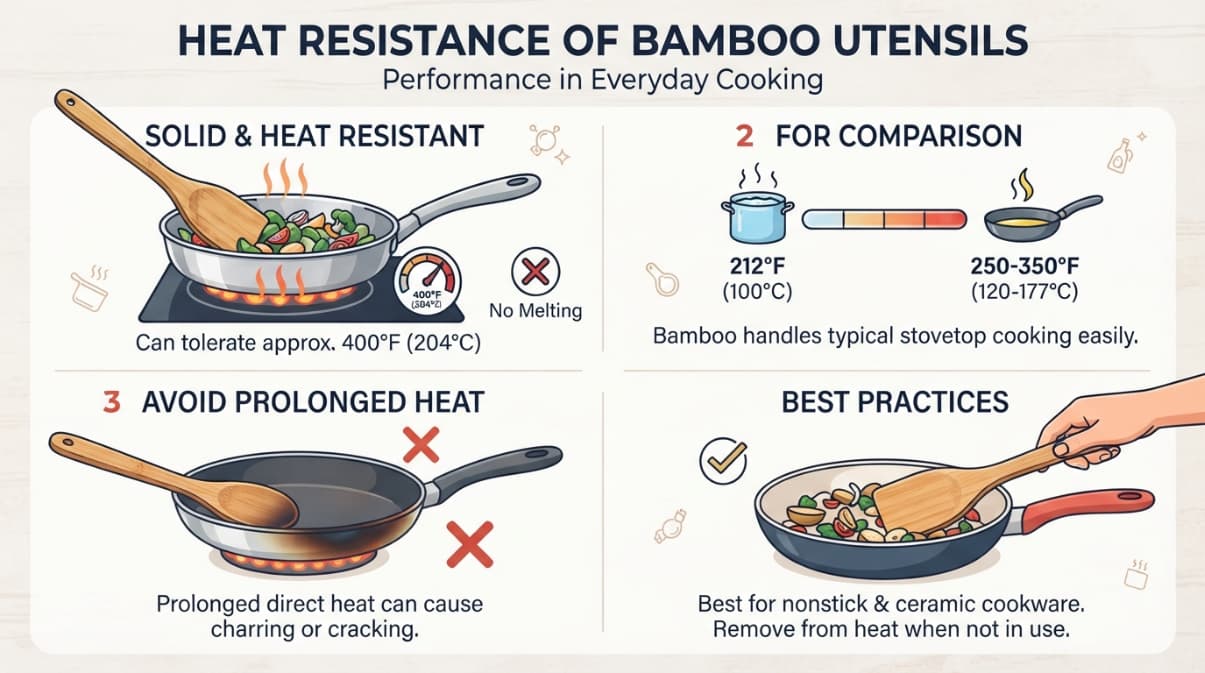
Heat resistance is one of the most common safety questions about bamboo cooking utensils. Solid bamboo performs well under normal cooking conditions and can tolerate temperatures around 400°F (204°C), although actual heat resistance varies with moisture content, construction, and surface treatment.
For comparison, water boils at 212°F (100°C), while sautéing oil commonly reaches around 250–350°F (120–177°C). This means properly made bamboo utensils can handle typical stovetop cooking without melting or deforming.
Will Bamboo Melt or Warp in a Hot Pan?
Bamboo does not melt like plastic, but prolonged exposure to intense heat can cause discoloration, drying, cracking, or charring.
Avoid leaving a bamboo spoon or spatula resting directly against a hot pan, burner, or other concentrated heat source for an extended period. With normal use, however, bamboo utensils are well suited to everyday cooking and are particularly gentle on nonstick and ceramic cookware.
| Utensil Material | Safe Heat Threshold | Behavior Under Heat |
|---|---|---|
| Solid Bamboo | ~400°F (204°C) | Browns/chars if left in direct contact too long |
| Silicone | ~350°F (177°C) | Softens near upper limit, does not melt |
| Bamboo-Melamine Composite | Not safe above 160°F (70°C) | Leaches formaldehyde when heated |
| PTFE/Teflon-coated tools | ~464°F | Releases toxic fumes above threshold |
Why Is Melamine the Real Safety Risk, Not Bamboo Itself?
The main safety concern with some products marketed as "bamboo fiber" is not bamboo itself, but the melamine-formaldehyde resin used to bind and mold the material.
Unlike solid bamboo utensils, many bamboo-fiber products are made by grinding bamboo into powder and combining it with synthetic resin. When these products are exposed to high temperatures, the resin can increase the migration of certain substances into food or beverages. This is why buyers should be particularly cautious with bamboo-fiber tableware intended for hot food or drinks.
What Is Bamboo Fiber and Why Does It Matter?
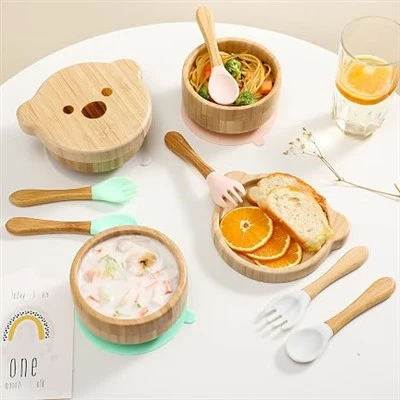
"Bamboo fiber" does not necessarily mean a utensil is made from solid bamboo. Some molded products combine finely ground bamboo material with melamine resin to create cups, plates, and other tableware.
Testing by Germany's Federal Institute for Risk Assessment (BfR) has raised concerns about such bamboo-melamine products, particularly when used with hot liquids. In testing of 228 bamboo-containing cup samples, migration of certain substances exceeded applicable European limits in a significant proportion of samples when exposed to temperatures above 70°C.
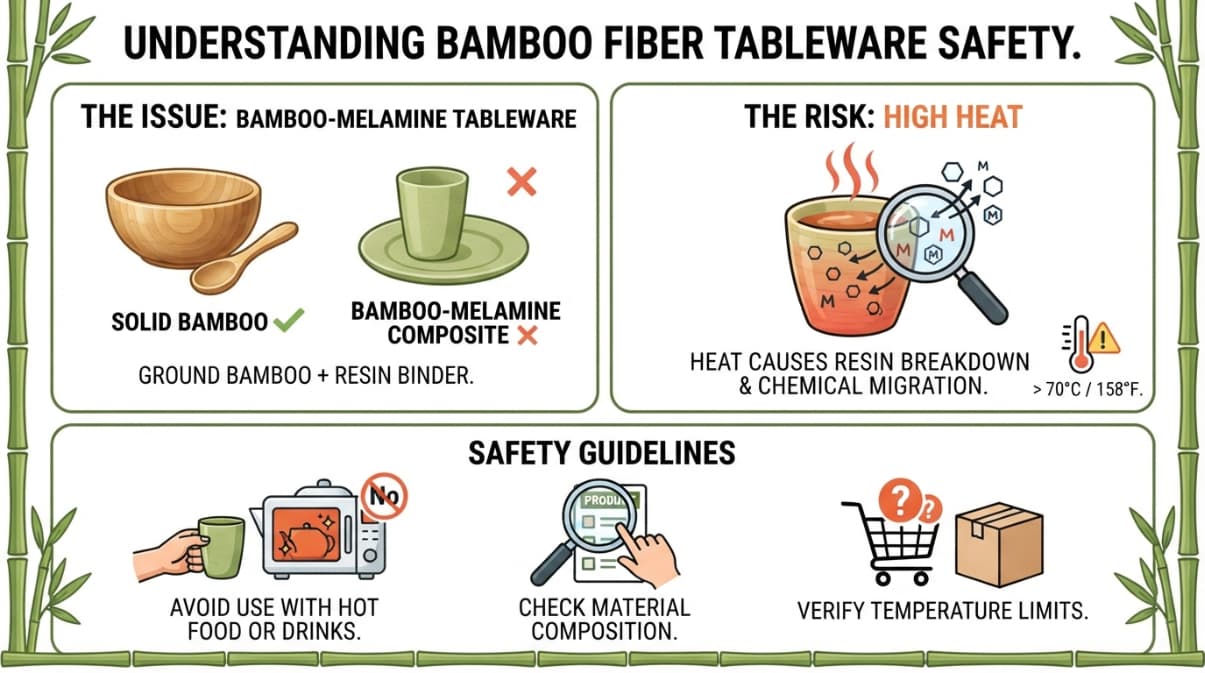
For buyers, the important distinction is simple: solid bamboo utensils and bamboo-melamine composite products are not the same material and should not be evaluated in the same way. Always check the material composition and intended temperature range before purchasing or sourcing bamboo kitchenware.
| Product Type | Material | Safe for Hot Food/Cooking? |
|---|---|---|
| Solid bamboo utensils | 100% bamboo, hot-pressed | Yes |
| Bamboo fiber / bamboo-melamine plates | Bamboo powder + melamine resin | Only below ~160°F, never microwave |
| Bamboo-handle, silicone-head tools | Bamboo + food-grade silicone | Yes, if silicone is the food-contact surface |
How Can You Tell If Bamboo Utensils Are Non-Toxic?
How to Identify Genuine Bamboo Cooking Utensils
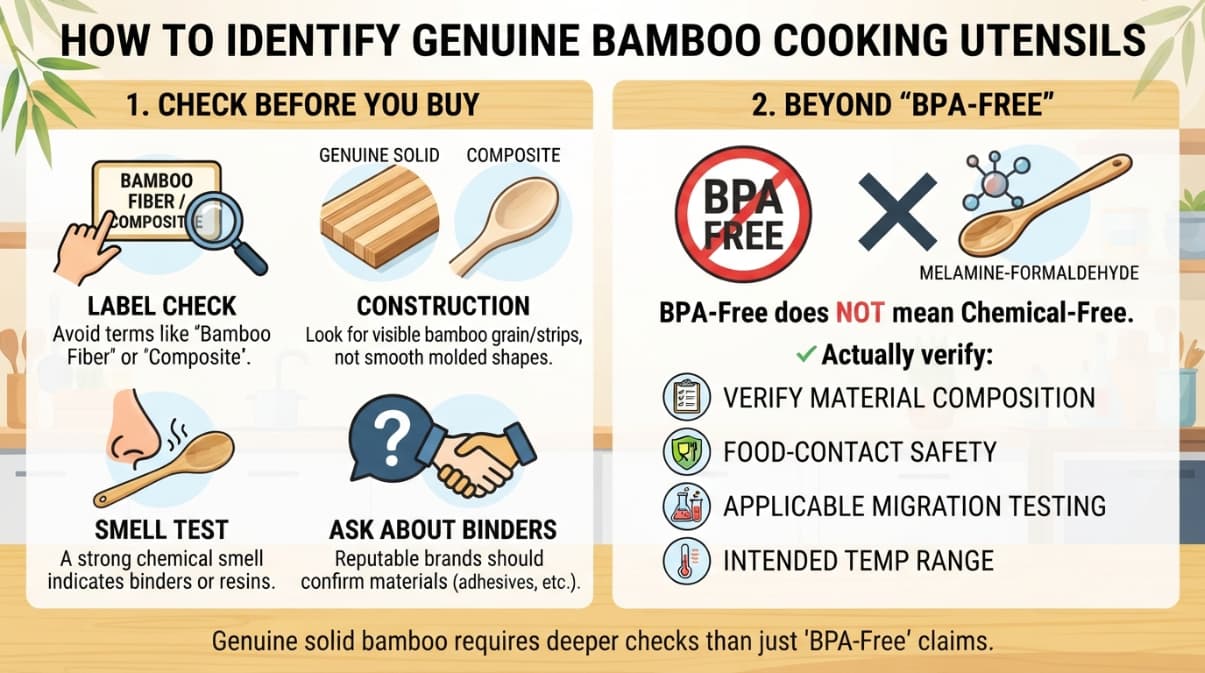
A few simple checks can help distinguish solid bamboo cooking utensils from composite alternatives before reviewing laboratory reports.
●Check the material description: Terms such as "bamboo fiber" or "bamboo composite" may indicate a molded composite rather than solid bamboo.
●Inspect the construction: Single-piece bamboo or clearly visible laminated bamboo strips are typical of solid bamboo products. Smooth, ceramic-like molded shapes may indicate a composite material.
●Check for unusual odors: A strong chemical smell can indicate adhesives, resins, or coatings that require further verification.
●Ask about binders: A reputable manufacturer should be able to clearly identify whether the product uses adhesives, resins, or mechanical processing.
Are BPA-Free Bamboo Utensils the Same as Non-Toxic?
No. BPA-free does not automatically mean chemical-free or suitable for every application. BPA is only one potential chemical concern. A bamboo-melamine composite can be BPA-free while still containing melamine-formaldehyde resin.
For genuine solid bamboo utensils, buyers should look beyond a simple "BPA-free" claim and verify the material composition, food-contact safety, applicable migration testing, and intended temperature range.
What Certifications Confirm Bamboo Utensils Are Safe?
Certifications turn a safety claim into a verifiable fact, and buyers of organic bamboo cooking utensils or bulk kitchenware should request them before ordering.
| Certification | What It Confirms |
|---|---|
| FDA Food Contact Compliance | No harmful substance migration under normal use (US market) |
| LFGB | Strict food-contact material safety standard (EU/Germany) |
| FSC Chain of Custody | Bamboo sourced from responsibly managed forests |
| PFAS-Free Documentation | No fluoropolymer coatings present |
| ISO 9001 | Consistent manufacturing quality control |
Buyers should confirm the cutlery is solid bamboo with no melamine or resin, request documentation proving it's PFAS-free, and physically inspect samples for splinters or rough edges before ordering at scale.
Do Bamboo Utensils Carry Bacteria or Mold Risks?
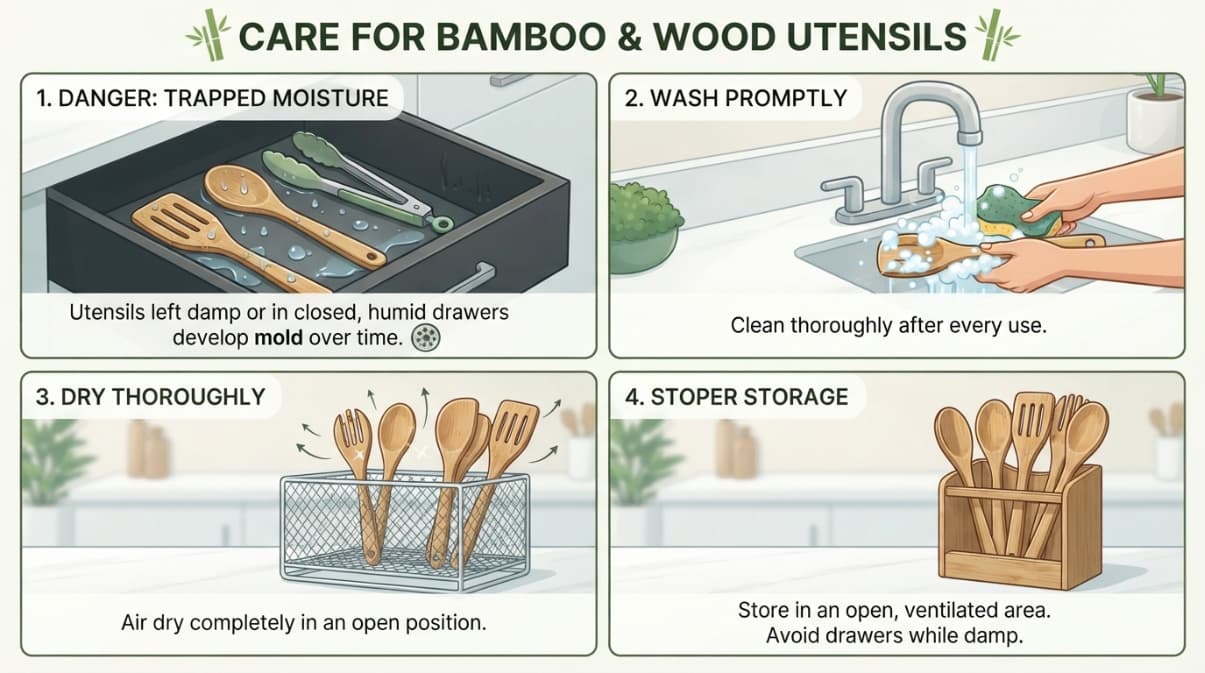
Bamboo itself is not inherently risky, but like other porous natural materials, it needs proper cleaning and drying to remain hygienic. Utensils that are left wet or stored in poorly ventilated, humid conditions can develop surface mold over time.
This is primarily a moisture-management issue, not a defect unique to bamboo. Wood utensils can experience the same problem when moisture is trapped in the material.
To reduce the risk, wash bamboo utensils promptly, dry them thoroughly in an open position, and avoid storing them while damp. Natural antimicrobial properties, where present, should not be treated as a substitute for proper hygiene and maintenance.
How Should You Use Bamboo Utensils Safely Every Day?
A few simple habits can help bamboo cooking utensils perform safely for years rather than months:
Hand-wash promptly and avoid the dishwasher, where prolonged heat and moisture can accelerate cracking and warping.
Air-dry upright rather than leaving utensils flat or in a damp pile.
Avoid prolonged direct contact with intense heat, such as resting a utensil against a hot pan or burner.
Condition periodically with food-grade mineral oil to help prevent excessive drying and cracking.
Replace damaged utensils once deep cracks, splinters, splitting, or persistent odors develop.

The Real Answer, in One Line
Solid bamboo is generally safe for cooking when properly manufactured and maintained - the key concern is what has been added to the bamboo, not the bamboo itself. Check the material composition, construction, and food-contact documentation rather than relying on marketing claims alone.
At Guanglong Bamboo & Wood Co., Ltd., we manufacture solid, melamine-free bamboo kitchenware with documented material and food-contact specifications. Explore our bamboo utensils and kitchen accessories catalog to review available constructions, finishes, certifications, and customization options for your market.
Further reading
What Are Bamboo Kitchen Utensils?
How To Choose High-Quality Bamboo Kitchen Utensils: A Buyer's Guide
Bamboo Vs Wood Kitchen Utensils: Which Is Better?
FAQ
Q: Can bamboo utensils go in boiling water or hot oil?
A: Yes. Properly made solid bamboo utensils can handle normal cooking temperatures, including boiling water at 212°F (100°C) and typical sautéing oil temperatures. Avoid prolonged exposure to direct heat or flames.
Q: Are all "bamboo fiber" products unsafe?
A: No, but some bamboo-fiber products contain melamine resin. Always check the material composition and temperature-use instructions, and avoid using products containing melamine resin with very hot food or in the microwave unless specifically approved for that use.
Q: How do I know if my bamboo utensil is solid bamboo or a composite?
A: Solid bamboo typically shows natural grain, fiber patterns, or laminated strip construction. Composite "bamboo fiber" products are often smooth, molded, and ceramic-like in appearance. When in doubt, ask the manufacturer for the exact material composition and food-contact documentation.
Notes and Definitions
Melamine-formaldehyde resin - a synthetic binder used in some "bamboo fiber" products; releases formaldehyde when heated above roughly 160°F.
Bamboo fiber / bamboo composite - ground bamboo powder mixed with resin and molded, distinct from solid, hot-pressed bamboo.
PFAS - per- and polyfluoroalkyl substances, synthetic chemicals used in some nonstick coatings, linked to health risks when ingested or inhaled.
FSC Chain of Custody - certification tracking bamboo from a responsibly managed source through manufacturing.
Migration testing - laboratory testing measuring whether chemicals transfer from a material into food under real-use conditions.
References
Are Bamboo Utensils Safe? FDA, Chemical & Food Safety Guide - Friendly Bamboo
Are Bamboo Cooking Utensils Safe? - Lilly Teak
5 (Truly) Healthiest Cooking Utensil Materials & Brands - The Good Life Designs
Be Careful with Bamboo Tableware - Bioplastics News
Are Bamboo Melamine Plates Safe? A 2025 Expert Guide - Duramela